The promise is noisy. The workflow is real.
26 May 2026
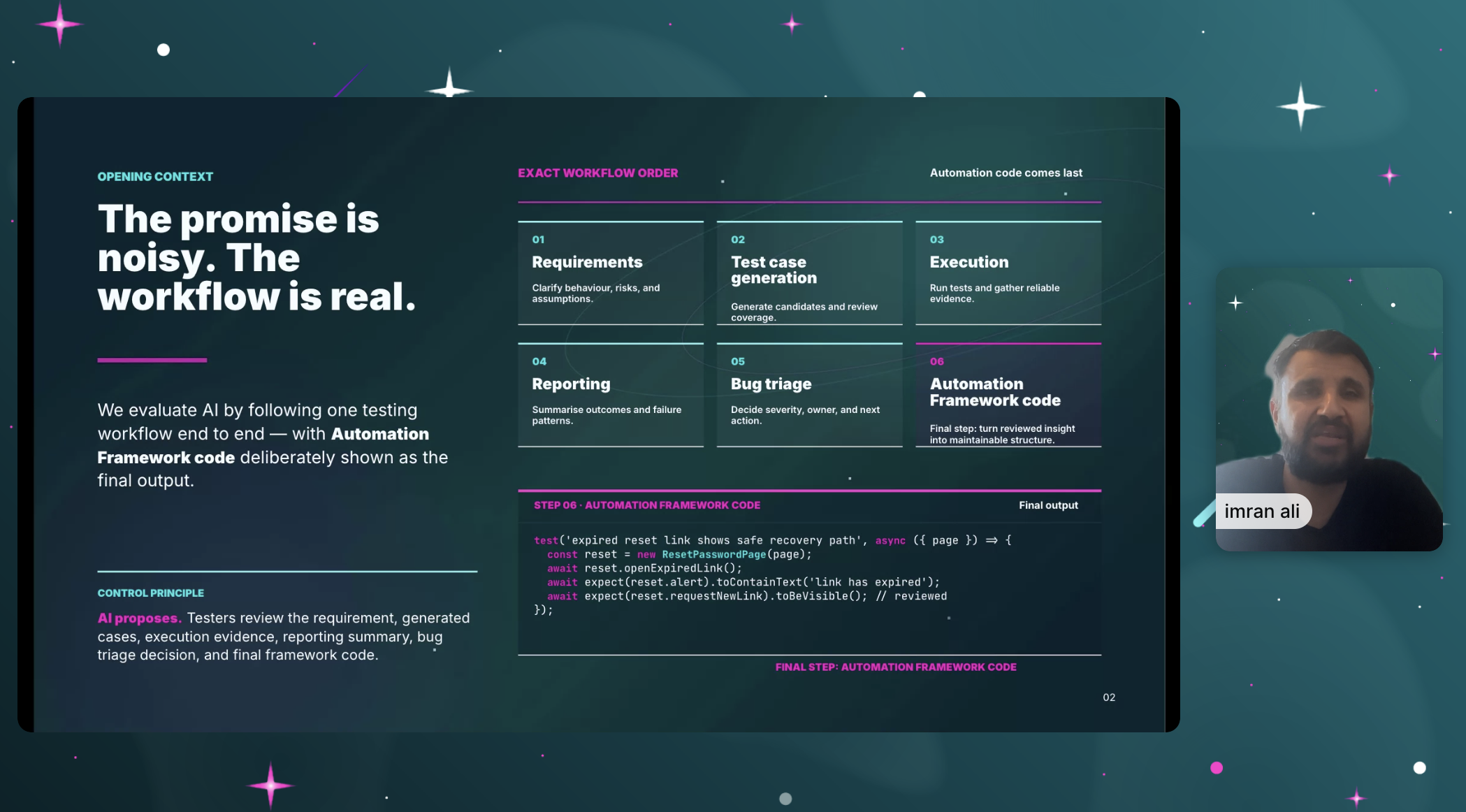
In this moment:
Imran Ali
Key messages from Imran's Masterclass: AI-driven testing in practice: from requirements to reliable automation.
What AI should be and shouldn't be
What AI should be and shouldn't be
- AI is useful when it expands options.
- AI is risky when treated as a verdict.
- AI is a research assistant. The tester is the professional.
- Far deeper ownership is not for AI. Avoid handing over business-rule interpretation, release readiness, final defect ownership.
What about speed?
- Testers feel pressured to deliver. Obvious risks are obvious. The constraint isn't capability, it's time, breadth and recall under pressure. AI is valuable when it comes to breadth.
- You always need human in the loop for every stage gate as we (humans) are responsible.
- AI is an accelerator and gives us edge cases but we must check the output.
- Questions slow us down but it's important to ask them about the test cases.
What's the connection between automation, AI and self-healing?
- Self-healing is when the automation in the AI runs, you have tests that may fail. The AI will try to loop around and fix those tests. It fixes the tests so it works without human interventions. There needs to be some human intervention.
- When prompting for test cases make sure to know how to ask. Don't ask AI to write test cases. You want to prompt in a way that helps to surface assumptions, expose gaps and risks.
- Self healing must never rewrite intent. If it's changing the assertion so the test goes from red to green then this is dangerous.
- Never patch around a failure with self-healing.
- Don't change requirements with self-healing. Triage if the failure might represent changed behaviour, changed requirements or a defect.
Are we misusing AI?
- AI is good at a fast draft, nice syntax and assertion.
- Tester or SDET owns the architecture and test strategy.
- Make sure to clarify behaviour.
- Don't let it define the shape of the test system.
- Good automation is still boringly disciplined, even with AI.
Where does test execution fit in?
- First reporting is pattern recognition across messy run evidence. AI turns failure noise into clusters, they don't identify root cause, severity or release risk.
What happens at the bug triage stage?
- Triage is expensive because context is scattered
- Assembling enough context to make a bug report useful is the challenge. Have to consider evidence, conversation, severity, duplicates, routing, and the decision gap.
- AI helps most by gathering and organising the package. The tester still owns severity, confidence and next action/steps.
Train the AI
- Train outcomes and examples to improve the memory of the AI.
AI will not replace us, AI will accelerate us but only if you know how to use it in the best way.
Thanks for an insightful Masterclass, Imran. Folks can follow up with Imran's tool, TestComet.
Defo watch the on-demand version of the Masterclass when it's available. I'll come back to this and add a link when ready.

Simon Tomes
Community Lead at MoTaverse
he/him
Hello, I'm Simon. Since 2003 I've had various roles in testing, tech leadership and coaching. I believe in the power of collaboration, creativity and community. 🎓 MoT-STEC qualified.
Sign in
to comment

With servers in >250 cities around the world, check your site for localization problems, broken GDPR banners, etc.
Explore MoT
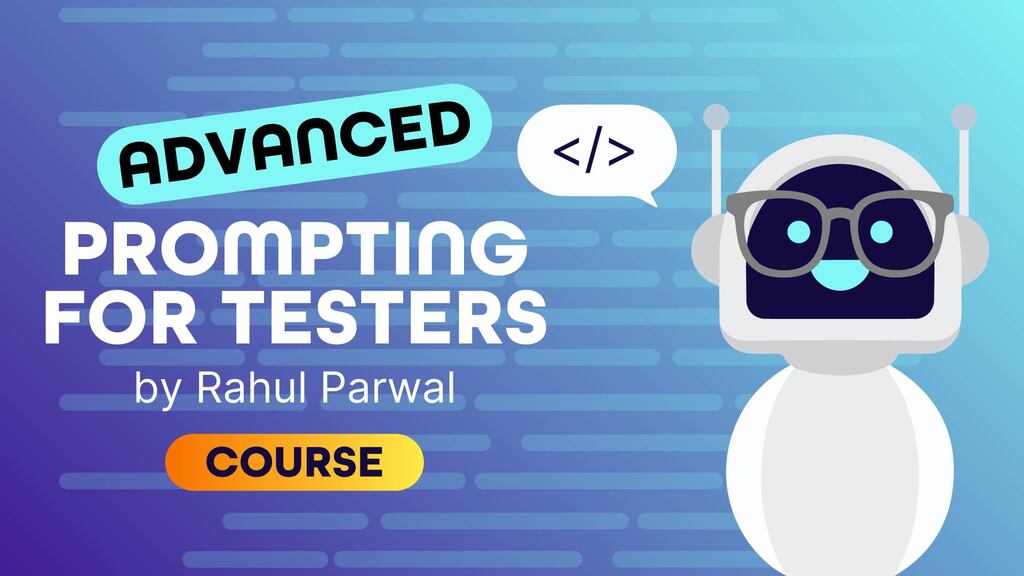
Advanced prompting skills to turn AI into your trusted testing companion.
Debrief the week in Quality via a community radio show hosted by Simon Tomes and members of the community
