When people talk about artificial intelligence (AI), those conversations are often focused on speed of output and automation. However, that misses a vital aspect that is not being called out or surfaced.
AI can accelerate output, but only humans can actually think. And thinking is where quality begins.
AI will generate requirements, create test cases and user stories, and significantly reduce the need for humans for that part. AI can certainly do those things, but accepted at face value, it risks overlooking an important distinction. Processing information quickly and creating output fast are not the same as thinking it through and making considered decisions. That is the main problem because thinking is where real quality begins.
In this article, you will learn how to identify your default thinking. Understanding your natural thinking tendencies when approaching software, testing, or requirements analysis will help you recognise both their strengths and limitations.
You will also learn how to apply multiple testing mindsets to your work using the Mindset Model. You will be able to practise intentionally shifting your mindset to uncover hidden risks, assumptions, alternative interpretations and less‑obvious insights.
Think deeper. Think better. Think Quality! Because the quality of thinking that goes into a task determines the quality of the outcome.
Thinking matters more than ever
As mentioned, AI accelerates output, but there is no guarantee insights are keeping pace. A lack of ability to reason about the intent of something, a lack of questioning anything without specific instructions, and no awareness of the consequences of its actions make AI a troubling creator.
Humans are uniquely complex individuals capable of great empathy, sympathy, and sadly, exploitation. While it can make a good impression, it cannot interpret incomplete or ambiguous information. And anyone who has worked on any software development project will agree that it is often just part of the job to know when something is incomplete or ambiguous.
AI does not feel, so there is no confusion because it will just make something up to fill the gap. It won’t get frustrated or delighted with software, so finding usability issues is a real struggle. Despite what some say, AI does not judge, so it cannot apply judgement to decide what really matters in a situation or why. For AI, time is not limited, so there are no regrets or hope. Because AI has no memories, culture, or expectations, it cannot offer subjective interpretation. Which is why it gives what it computes the answer will look like. And don’t get me started on context!
Just like AI, our default thinking isn’t enough. It probably never was enough, and many people have found ideas, techniques, heuristics, and so on to help them. Shallow thinking is easy, and everyone can do it. Deep thinking, intentional thinking, are skills we are paid for. One that AI may never emulate, no matter how plausible some answers may sound.
The mindset model helps us understand that there are a multitude of approaches to thinking about a problem, a system, risks and so on. They all have strengths and weaknesses, but by employing the right mindset, we can uncover what AI will never see. AI creates based only on what it knows. Thinking improves ideas. The quality professionals who can outthink AI are the ones with the most value.
Ready for expanded awareness? Then read on.
What AI doesn’t understand
Quality comes from many things. Judgement, interpretation, and context, amongst others. While AI is great at identifying patterns, processing large amounts of data, and producing convincing-looking outputs, it does not really understand intent, ambiguity, or consequences the way people do. AI doesn’t feel. It won’t get frustrated that something isn’t intuitive, easy, or obvious. It cannot add its own context. Its fundamental flaw is that, no matter how good it gets at mimicking human conversations, it is not and never will be human. Or have a true concept of the human experience.
That is where testers and Quality Engineers can excel. Interpreting incomplete information, questioning assumptions, and recognising risks that are not immediately visible. A valuable skill is setting emotion aside and evaluating and analysing with complete focus. But emotions are valuable too. If something is frustrating in testing, you can bet it will be worse for a customer, user, or client. As automation and AI increase, these human thinking activities become more valuable rather than less.
In this article, we’re going to look at the human mind and how testing is a thinking discipline. Going forward, our ability to think, feel, and reason will make us more valuable, not less.
Building on ideas from my Ministry of Testing article, "I think, therefore I test: the importance of thinking for testers," we’ll explore why your brain is the most powerful tool in your toolkit. How different approaches influence how we explore software, evaluate risk, and make decisions. Through a series of practical tasks, you’ll identify your "default" way of thinking. (I use ‘default’ not as a fixed thing here, but as a tendency or ‘go-to’ approach.)
Are you a sceptic, an explorer, or perhaps more holistic by nature? None of these is right or wrong, but each one shapes what you more easily notice and what might be a bit more elusive.
We’ll dive into the Mindset Model first to explore different viewpoints on testing mindsets and help you broaden your perspectives. By learning when to apply different ways of thinking, you can uncover risks earlier, ask better questions, and make your testing more intentional. By doing so, we can build on the great work you already do and expand your knowledge and awareness.
You will leave with a personal thinking toolkit. A set of perspectives you can apply to everyday testing and development work, particularly in environments increasingly supported by AI. Helping you build on your approach to understanding, analysis, and testing. Something you can apply in your daily routine, no matter what tasks you do.
The Mindsets Model
In the article, I think, therefore I test: the importance of thinking for testers, I introduced the idea of testers having different mindsets, rather than a single ‘testing mindset’. From my early days in testing, I’d heard that testers had a different mindset or a “testing mindset”. Yet no one seemed to know exactly what that was, or could define it. There were some loose ideas around thinking more about sad path tests, or negative testing. Some even mentioned risk before risk-based testing became a common term.
So that is where my interest in mindsets and thinking began. Things bubbled away for quite a while until I created my theory that testers have multiple mindsets. After some initial ideas and building on them over time, my first published list was in the ‘I think, therefore I test’ article. Since then, I’ve expanded and updated them, and the new, current list of categories and mindsets is below with further explanations.
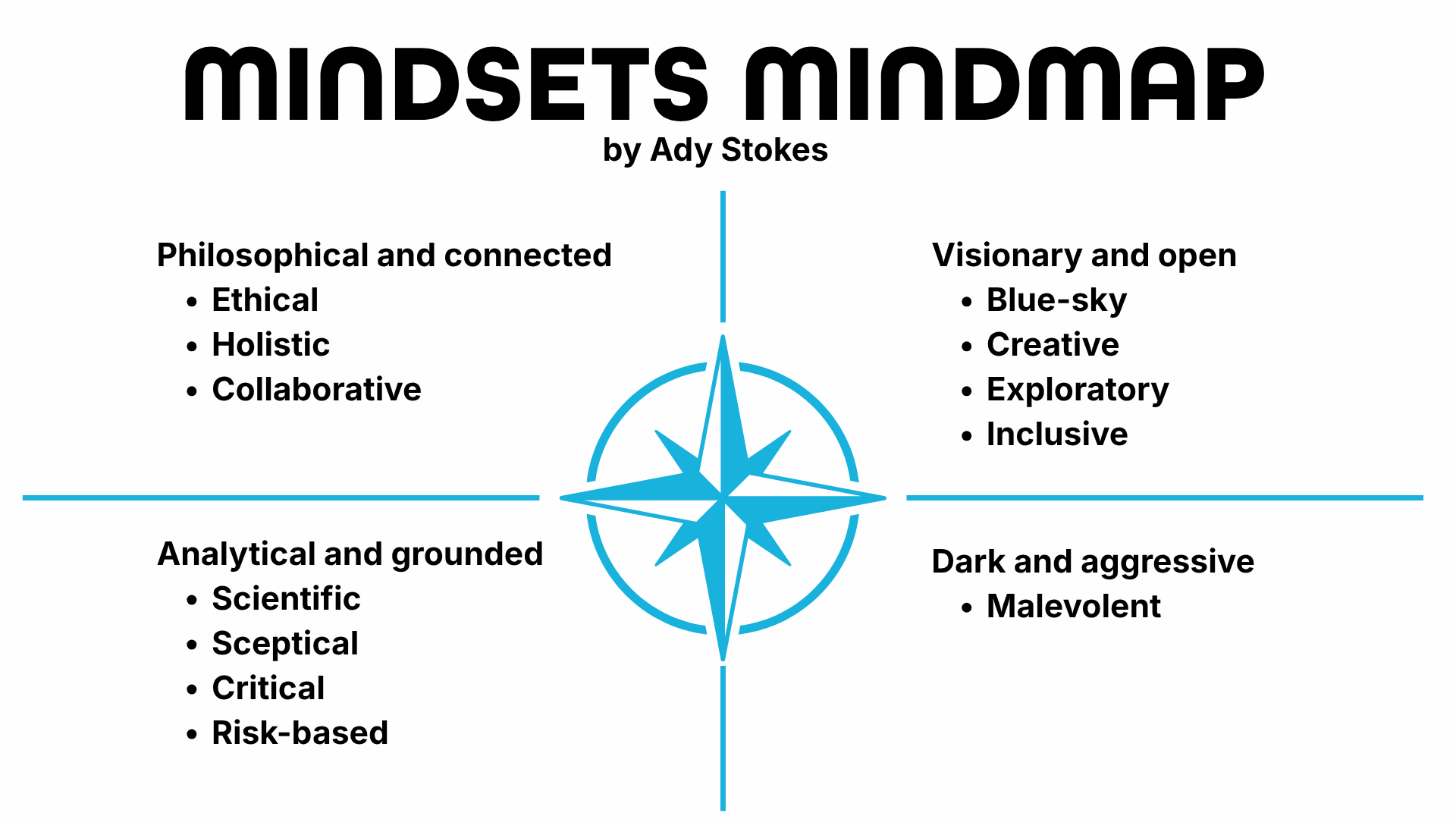
Think of mindsets as lenses of focus. They each have strengths and weaknesses, but the real value is understanding those and using several to gain a truly rounded analysis. The following mindsets are broken into four distinct categories, and each has a brief explanation.
Visionary and open
These help you imagine possibilities AI are unlikely to find
- Blue-sky (innovator): A blue-sky mindset is one for the innovator. Someone who can look beyond what is in front of them and see the potential.
- Creative (visionary): A creative mindset is for the visionary. Similar to the innovator, they turn potential into the possible.
- Exploratory (investigator): They can follow the untravelled path to discoveries
- Inclusive (ally): They think beyond themselves about all the different ways software is used and interacted with
Analytical and grounded
These help you validate and confirm facts and theories
- Scientific (realist): A reliance on evidence, tests, and logic to develop theories and ways to prove or disprove them
- Sceptical (analyst): Accepts nothing at face value. Is always questioning because they want to know why
- Critical (evaluator): Uses multiple evaluation techniques to look for strengths and weaknesses, explanations, and hidden biases
- Risk-based (strategist): Evaluates and identifies vulnerabilities that could cause impacts, and seeks mitigation strategies for each
Philosophical and connected
These help you evaluate impact and consequences
- Ethical (moralist): Focused on values, moral principles, fairness, responsibility, and honesty. Understands the consequences of actions and looks for the greatest good
- Holistic (connector): Assumes all aspects are interconnected and focuses on the whole system, from the smallest cog to the largest environment
- Collaborative (partner): Proactively reaches out to and works with others to share and grow knowledge through open communication for collective decision making
Dark and aggressive
This mindset helps you explore failure modes, aggressive intrusion, and destructive intent
- Malevolent (saboteur): Acts purposely to inflict damage or harm to a system through manipulation, exploitation, and exploration of the edges for weakness
Applying mindsets in quality
Whether we are aware of it or not, we all have default or go-to thought patterns, more commonly known as mindsets. An absolute must in our roles as thought workers is to think in multiple ways, question assumptions, challenge certainties, and think deeply. Without knowing your default, it is harder to initially notice what you are not thinking about. These exercises are designed to help you first identify your default and then practice switching from your default into other ways of thinking.
This section has several rounds, so take your time and do not rush. The goal is to take time to think so you can identify your self-learning and professional development opportunities. And we all know that doesn’t happen in a few minutes.
They follow a deliberate pattern of identify > understand > expand > and reflect
Self-assessment: Mindset switching drill
Below is a simple feature for an online retail website to help you identify your default, or go-to, approach. Feel free to choose an example from your workplace or one that more closely matches your industry. The feature is less relevant than the way you initially approach the task of thinking about it and then testing it.
Save for later toggle in shopping cartProvide a "Save for Later" button for items inside the active shopping cart. Clicking this moves the item out of the active checkout total and into a persistent "Saved for Later" list located directly below the cart. User Stories
|
Round 1: Identify your default mindset
Having read the feature description, answer the following questions:
- What is the first thing you would test?
- What concerns you the most about this feature?
- What questions would you ask, or what other information do you feel you need before testing?
Identify the mindsets that match your default thinking:
Now that you have answered those initial questions, it is time to identify your default thinking. Based on your initial thoughts, which mindset from the model is closest to them? If you are torn between two, that is ok. Put both of them down as your primary. What was next? Add that to your secondary mindset. Finally, think about all the other mindsets. Which do you rarely or never use? That could be an excellent learning opportunity.
| Blue‑sky | Creative | Exploratory | Inclusive | Scientific | Sceptical | Critical | Risk‑based | Ethical | Holistic | Collaborative | Malevolent |
What is your default pattern?
- Primary default mindset: ___________________________________
- Secondary mindset: ________________________________________
- A mindset you rarely use: ___________________________________
It’s ok if your primary and secondary mindsets are from the same category. That means you have a strong pull to one way of thinking. That isn’t wrong. It is just your default. You may find you pick two that are from different categories. That isn’t wrong either. There are no wrong answers here. There are only opportunities to understand ourselves better and embrace growth.
For the mindset you rarely use, really push yourself. If you don’t feel creative, choose it. If you don’t have a malevolent bone in your body, go for it. In this case, the more uncomfortable you are with your choice, the more you have to learn.
Examples:
- Primary default mindset: [Risk-based and Scientific]
- Secondary mindset: [Exploratory]
- A mindset you rarely use: [Ethical]
Now you have your starting point, let's look into why that is your preferred position.
Round 2: Understand your default mindset
Using your own notes, answer the following questions about your answers from round one, but take your time and don’t rush. The point of the exercise is to take time to think and understand your thinking:
- Observations: Why were those your first thoughts?
- Questions you would ask: Do you use a set of common questions for designers, developers, etc. that you always use?
- Risks or concerns: Why those risks or concerns?
- Possible bugs you might expect: Why do you expect them?
Now you understand what your starting point or default is. Let's intentionally expand to take in other mindsets.
Round 3: Trying different mindsets
Starting with the mindset identified as rarely used. Pick three mindsets from the model to use to review the feature again. Pick the ones you might never have thought of, or one you find interesting. Challenge yourself with your picks.
While reviewing, use each mindset to capture your observations as you think in that way. What possible bugs have you thought about?
You can choose three mindsets deliberately or at random. Try to push yourself to use ones that you wouldn’t naturally gravitate to. Use each one separately to re-review the feature. Below are some examples of what you might record.
| Mindset | Observations | Possible bugs |
|
Creative
|
Could be used by shoppers as a wish list, comparison tool, or to buy an outfit over time. Are saved items included in promotions, sales, or special codes? Do we have one-click restore to checkout, or one-click buy? Would customers think that ‘save for later’ reserves the item? |
Size or colour no longer available, not validated, or informed to the customer. Price change not validated. Quantity not retained. Restoring several at once could affect animation or transition to the shopping cart. Not saved across devices. |
|
Holistic
|
Totals for the cart, save for later, and the database must remain constant. Do guest and logged-in customers experience the same behaviour? How do the APIs and caching handle saved for later items, and how do we track them? |
Saved items still show in cart total. Session-only storage fails to retain saved items. Promotions, sales, or special codes or discounts are also applied to saved items, causing price discrepancies. Saved items are reserved, causing inventory availability issues. Audit trails and logging do not fully capture save for later data. |
|
Risk-based
|
Incorrect totals, charges, or discounts have cost and reputational damage risks. Any misleading behaviour about reserving items or pricing could cause regulatory risk. Operational risk of twice the cart use stressing services. |
Overcharging for a saved item due to issues in order cost calculations. Guests see other customers' saved items. Restoring an item not added back to cart due to failed rollback. Save and restore monitoring not robust enough to notice failures. |
Now that you have had a taste of thinking through different lenses, it is time to reflect, find some insights, and dig deeper to capture the learning.
Round 4: Reflection
Having completed the first three rounds of the switching drill, now is the time to step back and reflect on your experience.
Think about the following questions.
- Which mindset felt most natural and why?
- How did it feel thinking from a different or new perspective?
- Which mindset felt most uncomfortable to you, and why?
- What did you think about that you might not have had, or that might have taken you much longer to consider?
- Which mindset felt most uncomfortable, and why?
- Was anything about the whole process surprising to you?
There may be more for you to reflect on. How might this fit into your personal development? I’ve long been an advocate for quality people being generalists, and strengthening your thinking in testing is a high-value but little-acknowledged skill that is foundational to all other skills. Don’t neglect it.
Explore your own mindset
Why not try creating your own personal mindmap of mindsets? You don’t have to use the set in the model and can make up your own to fit you and how you think.
We've made a mindsets worksheet as a digital Word document to help you explore your mindset.
Or you may choose to use a prompt to help you get going.
|
Read https://www.ministryoftesting.com/insights/the-mindsets-quality-model/ and run the "Mindset switching drill" with me, all four rounds, in order. You are a facilitator, not a tester. Rules:
Use the "Save for Later" feature from the article unless I give you one of my own. At the very end, and only then, show me up to five observations or bugs I never reached. Label them as yours. Start with Round 1, question one. |
Whichever way you choose to explore, I’d love it if you could share in a comment, or in a memory tagging me. Just like you, I’m always learning.
To sum up
Thinking in testing underpins all other work. I’m a great believer that the quality of thinking that goes into a task, be that a project, a test plan, a design, or an exploratory testing session, directly affects the quality of the output. Without investing in how you think, you are missing out on so many opportunities. As a thought worker, you are literally paid to think. So investing in how you think is, to deliberately coin a phrase, a no-brainer!
Now that you know your starting point, you can challenge yourself and use the other mindsets to identify different risks and more assumptions.
Key takeaways:
- Identify your default thinking: Recognise your natural thinking tendencies when approaching software or requirements, and understand their strengths and limitations.
- Apply multiple mindsets to your work: Be able to practise intentionally shifting your mindset to uncover hidden risks, assumptions, alternative interpretations and less‑obvious insights.
- Build your own personal thinking toolkit: Develop a practical set of approaches to thinking that support exploration, analysis, and decision-making in day-to-day work.
I said at the beginning of this article,
“AI can accelerate output, but only humans can actually think. And thinking is where quality begins.”
Investment in your thinking is investment in the quality of your work and outcomes.
What do YOU think?
Building on the ideas in this article and your own experience, I'd love to hear your thoughts. Share them in the comments below. If you like, use the questions below as a starting point for discussion.
- Have you done other training in thinking or thinking systems? What were they, and how did they help?
- Did you consider thinking as a separate skill before reading this, or do you have a thinking skill listed on your CV?
- Share your default mindset and which ones you want to learn more about
- Do you have your own techniques or tools to promote thinking from different perspectives?
References:

MoT Ambassador. Currently semi-retired and freelancing. I am, amongst other things, a writer, speaker, and accessibility advocate. Leeds Chapter Lead. MoT Certs curator and article editor for WonderProxy. Testing wisdom, friendly, testing songs and poems. Great minds think differently. STEC and SQEC Certified. Struggling to write a book about testing mindsets and thinking's application in software development.
Comments