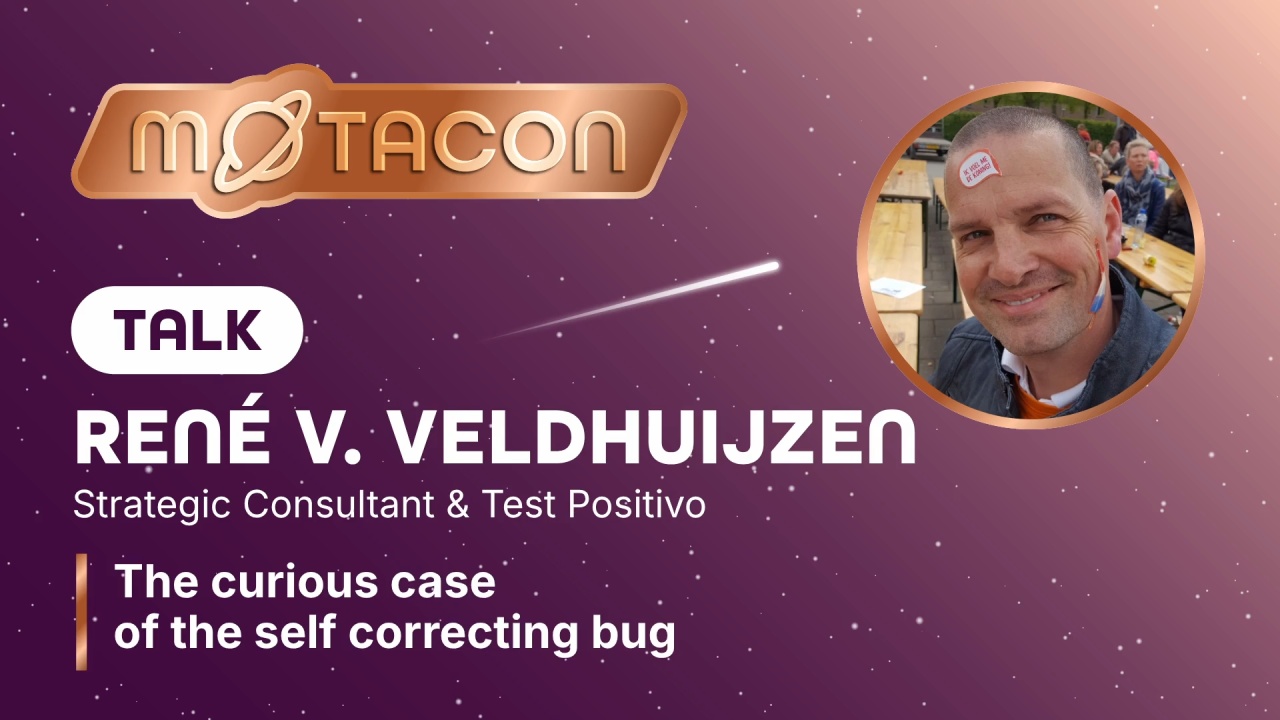
The curious case of the self correcting bug

-
Locked
Sometimes software behaves in ways we don’t expect. And sometimes it behaves in ways we REALLY don’t expect. Like the day a bug in my test suite quietly fixed itself. That moment became the spark for this talk about my learning curve into an AI‑augmented Test Specialist: an exploration of what happens when our tools start helping us in ways we never explicitly taught them to.
In my session, we dive into the emerging reality of testing with systems that observe, adapt, predict and occasionally surprise us. Instead of focusing on hype, we explore how testers can use these capabilities to build more resilient, human‑friendly systems, without losing our critical thinking, creativity or sense of fun.
Along the way, we’ll look at how this shift is already reshaping traditional QA practices. Inspired by that self‑correcting bug, we recently collaborated with a university in the Netherlands to modernize the classic Product Risk Analysis (PRA) using Agentic AI. In this initiative, autonomous agents continuously re‑evaluate risk factors, update likelihood‑impact matrices, and surface shifting dependencies based on real‑time telemetry and code‑change patterns. The result is a PRA model that behaves much like that surprising test suite: it adapts itself, recalibrates its assumptions, and highlights emerging risks long before humans would manually revisit the analysis.
Through real‑world examples and my vintage style of storytelling, we’ll explore:
- Patterns that reveal themselves before we notice them, like anomaly detection catching micro‑failures long before they escalate;
- Automation that stabilizes itself, from self‑healing selectors to frameworks that adapt to UI changes;
- Test data that becomes unexpectedly inventive, generating edge cases we wouldn’t have imagined in our wildest dreams;
- Tools that help us prioritize smarter, predicting which changes carry the highest risk;
- Systems that explain themselves, helping us uncover bias, assumptions and hidden logic;
- And a new kind of pair testing, where your digital companion suggests paths, combinations and hypotheses.
Rather than replacing testers, these capabilities invite us to evolve from bug hunters to quality architects who collaborate with adaptive tools to explore complexity, uncover risks and design systems that can bend without breaking. This talk is for testers, quality engineers and tech leaders who want to understand how to work with these emerging capabilities instead of against them.
What you’ll learn
- Understand adaptive and self-healing testing tools
- Recognize early-stage anomalies and emerging patterns
- Leverage AI-generated test data and edge cases
- Prioritize testing through predictive risk insights
- Evolve from bug hunter to Quality Architect



Comments