First published on The Big Test Theory.com in June 2017.
PS Personas– Technique Element
Sub-section – ApproachesPersonas element from the Periodic Table of Testing
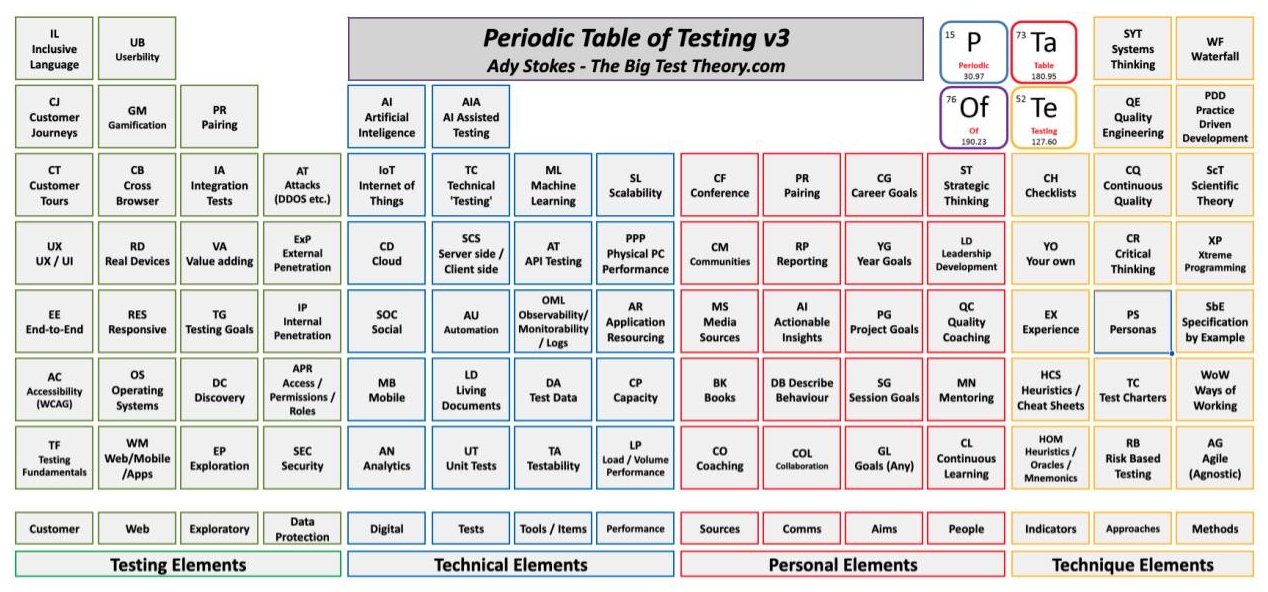
There are lots of relationships we have to consider in testing. In this post, I’ll briefly discuss those relationships and how the Periodic Table of Testing can be used to map them. Then share a real-life example of how using the personas' ‘thought technique’ led to using other elements on the table.
Any idea, technique or approach can only take you so far without some view of those things surrounding it. Even a Hermit (a person wanting no contact with others), no matter how isolated, has relationships that need to be considered, such as their surrounding environment.
Understanding relationships can often be instrumental in identifying appropriate scope that helps ensure we deliver quality in our products. The Periodic Table of Testing is exactly the same. A Technique Element can have a relationship to a Testing Element, and in turn a Testing Element can lead to (have a relationship with) a Technical (or any other) Element.
Real-world example:
Below is an example of how a Technique Element led our team to a Testing Element that helped describe our relationship with our Customers. By creating Customer Tours or Journeys, we could then mimic the Customers' behaviour, particularly when using Personas to navigate the system in a particular way. Those Tours and Journeys then lent themselves to a Technical implementation through automated tests and the creation of Living Documentation.
The Personas element led to the Customer Journey element, which made us consider both the client and server side in our testing
Working on a project to create a customer portal to access mortgage account information was a great opportunity to introduce personas. I’d read a lot about personas, but the main takeaway for me was how they could be used to highlight key differentiators. In our project, the key differentiation was the account's status at the point of use. I’ve read and seen a lot of information on personas, and some recommend highly detailed and complicated outlines. In our case, a lot of the detail in those was superfluous and didn’t add any real value. For projects lasting years, they could hold some worth, but for me, they were distractions from the reason for them.
Back to the project and our main differentiation. Mortgage accounts have several status variations, including the account being up to date, in arrears, under an arrangement, in litigation, in possession and so on. We used different personas to represent those different states.
With input from the team, we even used the names of the personas we created to represent variations in surnames and see how they would be displayed in the UI (on-screen). And so, Sally Steadman, Adam Thompson-Pritchard and Olivier O’Connell, amongst others, were ‘born’. While the personas had genders, ages and key personality traits, their development didn’t go much further as the status of their accounts was the key differentiation required. Once we had the personas and a shared understanding of what each one meant, we expanded the idea to other elements. As well as creating customer journeys for them and noting the different information and help items they would see, we wrote feature files for them that became both our automated testing and, in turn, our living documentation.
Thanks to our shared understanding, we were able to create a ‘Preview’ version of the site and add fake services. This meant you could register and sign in as one of the personas and explore or complete user journeys just as the Customer would, without needing the backend. We used these to run our automated UI tests, which gave us stable responses. Cool stuff, I thought, but this was 2017!
However, we might conduct testing, and wherever our starting point is, the relationships among different techniques and methods must be considered in our quest to investigate and add value to the best of our abilities.
MoT Ambassador. Currently semi-retired and freelancing. I am, amongst other things, a writer, speaker, and accessibility advocate. Leeds Chapter Lead. MoT Certs curator and article editor for WonderProxy. Testing wisdom, friendly, testing songs and poems. Great minds think differently. STEC and SQEC Certified. Struggling to write a book about testing mindsets and thinking's application in software development.
Boost your career in software testing with the MoT Software Testing Essentials Certificate. Learn essential skills, from basic testing techniques to advanced risk analysis, crafted by industry experts.
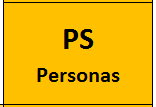 Personas element from the Periodic Table of Testing
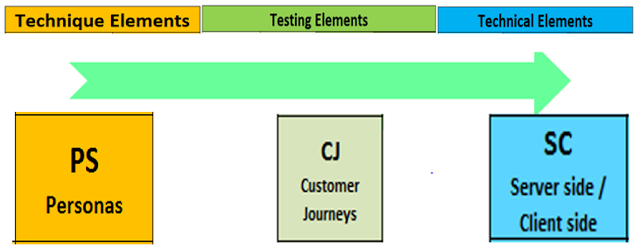 The Personas element led to the Customer Journey element, which made us consider both the client and server side in our testing