Building professional resilience: A guide to surviving job loss
Shift left on your career and build resilience before you need it.
In this article, you will find a how-to guide on preparing for job loss. Of course, we hope it does not happen to anyone. It is better to be prepared. Just as we hope we’ll never introduce a bug into a system and still prepare our testing accordingly, we’ll examine this through a lens of the professional development lifecycle and adopt a proactive shift-left. This approach can build confidence and resiliency into your job search and overall professional life.
When I started my career in 2012, I was told the average time at any given company is 5 years. A quick search says that number is trending lower, by some estimates down to 1 year. This is a hard truth for many to accept. The point is, the job you are working now is not the one you will retire at.
There are many reasons for this. Primarily, I believe the landscape shifts rapidly. It’s impossible for anyone to keep up fully, and ideas come and go quickly. As you stay in one job, your skills will atrophy. You’ll be locked into a grind, having learned all there is to easily learn and have implemented all your best ideas. You’ll start to stagnate the longer you stay. As management shifts either with new personnel or cultural changes, your prior accomplishments will become forgotten.
In short, your days are always numbered. Once you come to accept that, you can start building more resilience.
Dismissal, layoff, redundancy, fired. What’s the difference?
Legally, some of these terms are defined and impart certain rights and responsibilities. Colloquially, people interchange them to mean different things. If you’re curious about how your specific situation impacts your future employment, severance, etc contact an employment lawyer.
For the purpose of this post, I’m going to adopt the use of ‘dismissed’ meaning ‘a permanent end to your employment with the company.’ In real terms, you are without a job, and therefore likely without primary income. That is a problem we hope to remedy as quickly as possible.
A shift left: Building resilience along the way
Nearly anyone can be dismissed for nearly any reason at any time, with no warning. From personal experience, there’s not really any reason to overanalyse the situation. It is normal to become more skilled at your current job and often expected. It is also beneficial to refine your current skills to become better at your current tasks and learn new skills to fill gaps within the organization and your own knowledge. As a corollary, however, there’s also little use in attempting to safeguard yourself by becoming ‘invaluable’ at your job. The number of ‘invaluable’ people I’ve seen dismissed is many.
The key issue I have found is waiting until you are dismissed to think about being unemployed. By then you’ll find yourself scrambling to update your resume, upskill, and network. If that is your situation, don't worry, it can be resolved! But first we’re going to shift focus.
In testing, we’re no stranger to this. This is the same as treating testing as a phase that comes at the end of development, when critical issues are found all too late and are the most expensive to fix. This is why we advocate for shift-left. Testing early and often throughout the development lifecycle helps catch issues early before they become critical.
The same can be applied to your professional life. By considering your career and professional growth every day and inspecting and adapting along the way, you can build resiliency before that critical point of dismissal. If the thought of being dismissed scares you as much as a critical production issue slipping due to faulty processes, it’s time to shift left.
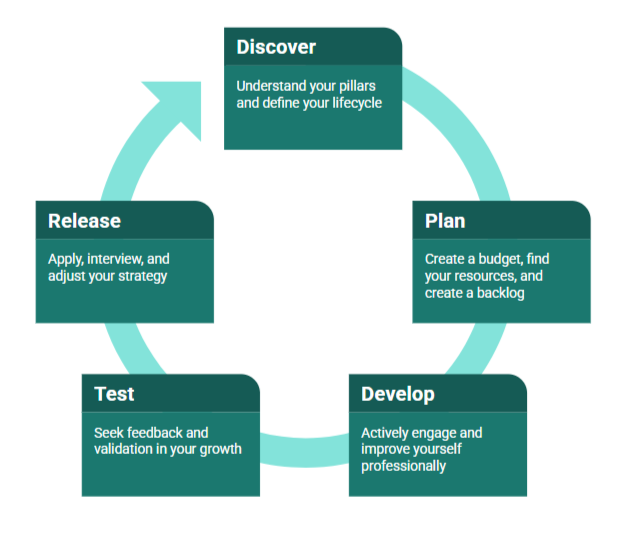
Discover: Creating a professional development lifecycle
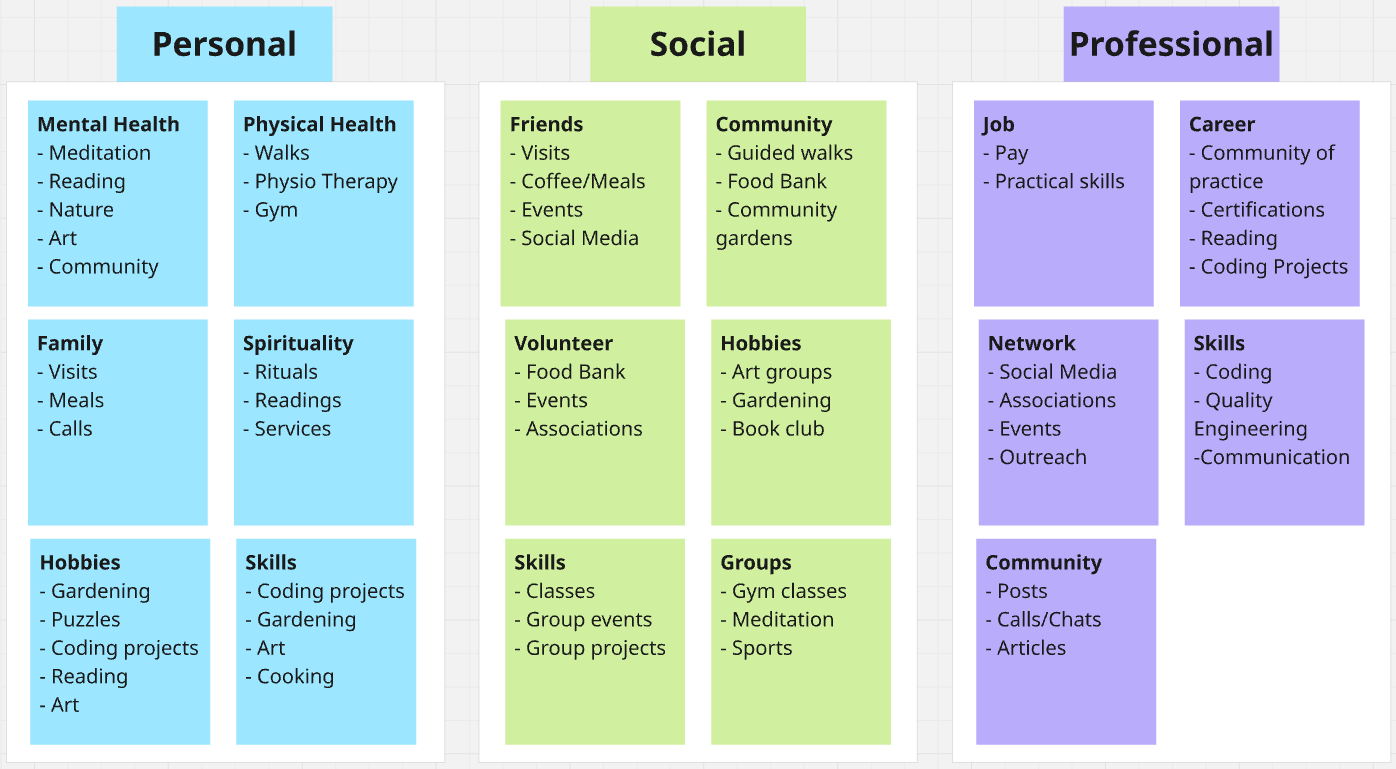
Just as a quality application lifecycle process creates a quality product, a similar concept can create quality professional growth. I find it useful to separate my life into three strategic pillars. Personal, professional, and social. Each of which contains aspects of my life that I want (or need) to spend time growing and maintaining to live a happy and healthy life. This helps me see the bigger picture, understand the cross-over areas, and identify areas of concern that I may want to address. Inside those pillars, I can create lifecycles for development and feedback loops.
Mine are my examples, and you could use them or create your own. Consider each of the pillars you create as different projects that each require development and maintenance. Neglect any pillar for too long, and you risk a critical production error or outage. Adopting an interactive development lifecycle for each allows them to be continuously built, maintained, and updated based on your current situation.
Below is an illustration of my pillars. Your personal pillars may be vastly different from mine, and that’s ok! It’s about your life and what you value. Perhaps by walking through mine, it may give you an idea of how to shape yours.
Each are my personal requirements for a resilient life as they support each other. A family connection can lead to community, which can lead to job opportunities. Equally, a job can create volunteer opportunities that lead to improved mental health. Any of these pillars can suffer a loss, and at that critical time, having strength in the others can help you rebuild. In this way, no single loss takes down the whole system.
Many activities may span multiple pillars, or an activity in one area may support an activity in another. A trip to the gym may be personal for my physical health, but it can also be a social activity if I choose to engage in a class or workshop, and it could support physical activities such as sports.
Learn to recognize the difference and what pillar you are actively working in at that moment. I may opt to tinker on small scripting projects as a personal hobby, and I often find myself drawing on those skills in my job or listing them on my resume. And there’s nothing wrong with this! It’s perfectly normal. By recognizing it, you set internal expectations. A very common trap is tinkering on side projects. That can and perhaps should simply be for fun. If you find it draining, it may be because you’re treating it like a side hustle and not a side hobby.
While this article does not focus on personal or social pillars, I do encourage them as they are deeply important. Too often I’ve seen people tie themselves deeply to their job and professional career. And when they find themselves dismissed, their whole identity is lost. I encourage everyone to define and develop a rich and fulfilling life outside their professional career, as it’s in those areas that we often find comfort in difficult times that can help lead us through.
Plan: Create a budget, find your resources, and create a backlog
Create a minimum viable income (MVI)
At the end of the day, jobs pay bills. When most people say they’re ‘not in it for the money’ they’re talking about not being millionaires. Everyone has bills they need to pay, and on some level, a job is the way to pay those bills. There is no shame in that. To understand this need, you need to create an accurate budget and understand your finances and financial situation.
I’m not here to give advice for maximizing your personal financial investments. I’m here to talk about MVI. What income do you need to survive? Consider this your Minimum Viable Product, your acceptance criteria for any job. This will help you quickly weed out job postings that do not meet your minimum, while giving you a reality check on your expectations.
You may well find yourself in a position where you’ll need to accept a lower salary than your prior job. How much is enough? A budget tells you how much you spend, but can also tell you how much you need. If you find yourself unemployed, stretching your savings and severance for an extra month can go a long way.
Begin by tracking your expenses. Month over month, where does your money go? How much of it is required (bills) and how much is discretionary spending? Where can you cut back if necessary? Once you have a budget, you can extrapolate that out to your minimum viable income.
From there, you can work to improve your financial situation. I know, easier said than done. But while you’re gainfully employed, take the time to reduce your debt. Cut back on discretionary spending, pay off high-interest accounts. Is there anything you can do to reduce your minimum viable income and eliminate mandatory monthly payments?
Finally, work on an emergency fund. The general advice is to have 3 months' minimum viable income in a high-interest savings account. This gives you a good cushion to survive any gaps in your employment, and can even give you the freedom to walk away from a bad job. A very great place to be financially and mentally.
Find professional development opportunities, communities of practice, podcasts, blogs, books
Build a backlog of learning. If you’re technically inclined, a personal GitHub account with projects can help. Otherwise, keep a list of books, blogs, courses, podcasts, and any and all learning material and make a backlog. If you don't know where to start or what to learn, look at the current job market and recent job postings. This can tell you current trends, what skills are in demand, and what those skills pay.
It won't take too long for you to have a big list of bookmarks. Once you have a fair number, you can begin to group them and prioritize them. Priority can be in terms of value, but also interest. It’s ok to go down rabbit holes for the sake of fun or general interest as well!
Develop: Actively engage and improve yourself professionally
If we return to the three pillars, note that ‘job’ is only part of the professional pillar. In my experience, not many jobs are keen on promoting the latest and greatest technology or adapting new processes. But your next job will be keen to hire for those skills. Developing yourself professionally means focusing on your long-term career, even if those skills are not relevant to your current job.
Burn down the backlog
Earlier you created a backlog of tasks, books, podcasts, and courses, and now it’s time to burn down that backlog. Just as building a quality product takes time and craftsmanship, apply that same focus here. It is easy to get overwhelmed with so much to be done. Set ‘Work In Progress’ limits so you’re not overwhelmed. Ensure you take good notes and set aside time to reflect and integrate new content with your experience and prior learnings. However you choose to divide your time, ensure you’re focusing on accomplishing tasks and truly learning from them, not simply starting them.
A personal blog to showcase what you’ve learned will not only help you remember, but also help future people see your growth. The Ministry of Testing offers many ways to mark and track your learning, and to promote the learning you’ve done in your profile. Have a look at mine (Shawn Vernier) as an example.
Find your community
Networking is incredibly important. Professional groups, meetups, online chats and forums can not only offer good learning opportunities but also help connect you to people that can in turn provide you with future opportunities. Find the ones that resonate with you, and join. The Ministry of Testing Pro Membership has many opportunities for networking and recognition within the testing community, with an active Slack and message board, chapters, and virtual events.
With this increased visibility, you can start to build a brand if you like. There is a concept of ‘Your One Word.’ If you used one word to describe yourself, what would it be? What is at the centre of what you do? Build out from there. In the age of AI, AI tends to ‘flatten’ a person. If you ask AI about a person, it will use their ‘greatest hits’ and extrapolate from there.
Finally, feed the algorithm. If you’re comfortable being online, learn a little about social media algorithms. If you’re comfortable creating content, post regularly, use hashtags, and don't post external links (for example, use LinkedIn’s blog, don't link to your personal website). If not, interact with the platform. Like, share, and comment on other people’s content. Add to the conversation where you can. Sending and accepting connection requests broadens your audience, and you never know what will come of it.
Test: Seek feedback and validation on your growth
Check the job market, apply for new roles, and keep your resume up to date
The best feedback in software development is a staging test environment. Occasionally check in on the market. Review job postings, see what the new skills are in the market, and adjust your development plan. If you see positions that interest you, apply! You don't have to wait until you’re unemployed to apply for a new role. The best feedback is a new job offer or a rejection letter. Either result tells you where you are and where you should go next.
Use your community of practice to validate your growth
Typically, when someone thinks of testing knowledge, they think of exams. While you certainly can take certification courses, usually those come with their own coursework. Many learning opportunities do not come with an exam at the end. Instead, engage with your network and community of practice. Have pragmatic conversations around new topics, ask questions, and invite debate. From books we learn, from others we experience, and that experience grounds our knowledge in practicality and fills in the details.
Release: Apply for jobs and adjust your strategy
Here you’ve reached the point of unemployment. Now we shift-right into production. With your free time, your professional development can expand rapidly. You’re not unemployed. You are professionally unemployed. The 40 hours/week you used to spend at a company can now be spent on that backlog you’ve accumulated. You now have the time to devote to your craft, something you are hopefully a little excited about. Use that time, and use that excitement.
Craft your resume from your experience
You now need to craft your resume and prepare for interviews. Resume advice moves quickly, and often conflicts. My take is recruiters are people, and they have personal preferences on how resumes should be formatted and what information should be included/excluded. You can't please everyone, so instead please yourself. Craft a resume that you think represents you. If a recruiter does not like how you’re presenting yourself, you’re very likely to run into cultural fit issues in the organization.
Impact statements can make a difference in how your accomplishments are received. Impact statements start with a key issue you identified, how you responded, and what measurable impact that response had. Give specific examples and statistics where possible that highlight the impact to the organization.
AI can give you a resume boost. Do some research about current recruitment processes and resume formats. ATS (Applicant Tracking System HR), iCMIS (Internet Collaborative Information Management Systems), CMS (Content Management System), and SWOT (Strengths, Weakness, Opportunities, Threats) all stand out currently as examples. Prompt AI to review your resume and give feedback specific to these methodologies, and use that to better hone your resume. AI agents can help suggest better formatting, keywords, use of metrics, and other tips to help your resume make it past the first stage.
A word of caution: resist the urge to have AI generate your resume. Recruiters do use counter-AI, and if a resume looks to be AI-generated, it can get rejected. The trick is ensuring you maintain a human-centric voice and use AI to guide your revisions.
Consider this your production environment. We don’t want bugs in production. Spend the time to craft your resume to your standards as a professional. Having ‘attention to detail’ listed as a skill on a resume with spelling errors is an embarrassing mistake. Your network can help you by reviewing and proofreading.
Find job boards and leverage your network
Job boards and websites change rapidly. Some web searching will give a good list and a solid direction to focus pretty quickly. Search as widely as possible, and gather as many job boards as you can. The Ministry of Testing maintains a job board to help your search.
When applying, do try to apply directly on the company website where possible. Job boards can be great for finding opportunities, but the company website can give you more information about the job and will often ask more specific filtering questions that will increase your odds of being seen. Further, the website will always send you a confirmation email, which is great for tracking.
AI can also scrape the internet for job postings, crawling multiple job boards and doing a lot of heavy lifting in your search. It can equally use those job postings to further refine your resume and guide your professional development by identifying key skills and skill gaps.
And remember you’re not alone. You have a professional network of people able and willing to help, if not directly with open roles, then indirectly with mentoring and guidance. Ask for assistance and have conversations as part of your lifecycle.
Happy Hunting
If during the ‘good times’ you’ve followed some of the advice above, you are likely well positioned. You have many levers to pull as you negotiate through a difficult time. You are now professionally unemployed. You now report to yourself, and it’s your responsibility to manage your resources.
With your pillars, you can fuel your physical and mental health by leaning into personal and social life to keep you mentally afloat. You also recognize that your job is only one part of your professional self, which will bring some comfort in still being able to engage in the professional community.
Your budget will allow you to calculate how long you can remain unemployed, giving you some deadlines to meet and allowing you to make decisions around trade-offs in potential job postings and job offers.
As you engage professionally, you can seek feedback on your skills and learn new ones along the way. You have people to commiserate with, and a network to help you succeed. We have all been here.
You are now well positioned to search for jobs that are the best fit for you, and your network may provide you with opportunities you were not able to find on your own. You have the resources you need to develop yourself professionally and to use your time effectively.
May this guide find you well. I hope it gives some inspiration and insight to guide you through difficult times. The job market is in constant flux. It is impossible to predict what is next with any certainty. So expect the unexpected. Build resilience into your professional life the same way you’d build quality into a product.
To sum up
Job loss is unfortunately common for many. Instead of treating unemployment as a critical production incident to be handled in panic, we can shift left and build resilience into our professional lives the same way we build quality into our products.
That means separating our lives into strategic pillars so that no single loss can take down the whole system. It means planning ahead. Building a budget and a minimum viable income, creating an emergency fund, and keeping a backlog of skills, courses, and communities. It means actively developing ourselves by burning down that backlog, setting WIP limits, and networking.
We enter staging by checking the job market, applying, and validating our growth through our community of practice rather than waiting for a formal exam. And when the release finally comes, it means treating our job search itself as a professional practice: crafting a resume that reflects who we are and leaning on our network and the resources we've gathered.
If we find ourselves dismissed, we won't be starting from zero. We'll already be in progress. Professionally unemployed, not professionally unprepared.
What do YOU think?
Got comments or thoughts? Share them in the comments box below. If you like, use the ideas below as starting points for reflection and discussion.
Questions to discuss
- What areas of professional development will you be focusing on?
- What role does community play in your personal or professional life?
- Is it possible to adopt any other engineering methodology within the professional development context?
- What would you consider the biggest boost to your professional development currently?
Actions to take
- Take the time to nurture your mental and physical health
- Assess your professional life holistically and find the gaps and key risks
- Build a budget and assess your minimum viable income
- Develop yourself professionally, learn new skills, and engage in the community
The answer to quality is context.
Comments