Mapping the Machine: What Fell Out of an LLM Wiki Idea
22 Jul 2026
In this moment:
Lisa Crispin
Justin Holsgrove
Lisa Crispin linked Andrej Karpathy's LLM Wiki over on the MoT Slack. The idea: instead of re-reading raw sources every time you have a question, you let an LLM maintain a compounding, cross-linked markdown wiki you browse in Obsidian. I read it, I already had Obsidian, and I wondered — could this help me get my arms around our platform?
Turns out I didn't want notes, or a wiki. I wanted to see the system.
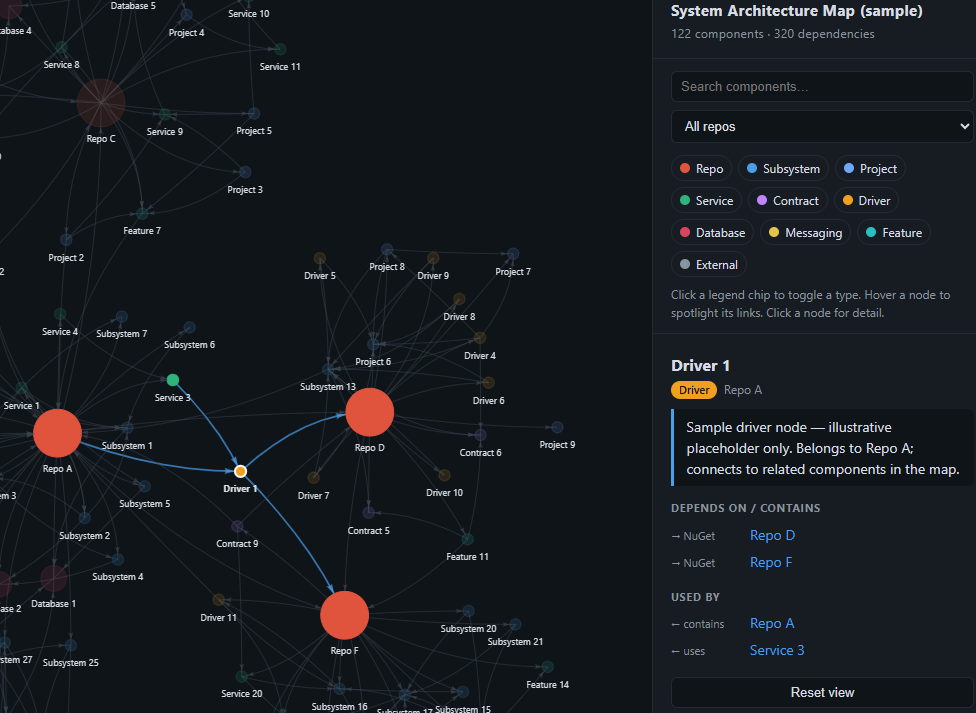
So, borrowing the Obsidian model, I had Claude fan out one agent per repo across our multi-repo ecosystem, in parallel. Each one read the real code: solution files, project references, DI registration, function entrypoints and reported back the components it found and how they connect. I stitched those together against our cross-repo coordination graph (a map our main CLAUDE.md already references) so the backbone of repos, databases, the service bus etc, stayed accurate, then generated the whole thing into an Obsidian vault. This could go down to class level but I suspect that would make the map unreadable.
The result:
Turns out I didn't want notes, or a wiki. I wanted to see the system.
So, borrowing the Obsidian model, I had Claude fan out one agent per repo across our multi-repo ecosystem, in parallel. Each one read the real code: solution files, project references, DI registration, function entrypoints and reported back the components it found and how they connect. I stitched those together against our cross-repo coordination graph (a map our main CLAUDE.md already references) so the backbone of repos, databases, the service bus etc, stayed accurate, then generated the whole thing into an Obsidian vault. This could go down to class level but I suspect that would make the map unreadable.
The result:
- 122 components, 320 dependencies - subsystems, services, drivers, databases, message contracts, features
- One note per component, each with a plain-English "what it does / why QA cares" summary
- Every dependency is a link, so Obsidian's graph view draws the actual architecture, coloured by component type
- A self-contained HTML export (vis-network) I dropped on a VM - teammates open a URL, hover a node to spotlight its connections, click for detail, filter and search
This is absolutely not what the gist was about. The LLM Wiki is fed - papers, tickets, docs ingested over time until they accrete into synthesised knowledge. What I built is scanned out of code in one shot. It's a map, not a knowledge base.
I went for a map because our architecture docs are out of date and stuck in awful formats - Visio, PowerPoint and friends. Obsidian links items cleanly and Claude exports it easily, so I ended up with two shareable versions: an Obsidian vault and a standalone JavaScript build.
But I think the two are complementary. The map gives me the structure, what exists and how it wires together. The next move is to bring it back in line with the original intent: ingest stories, PRs, bug write-ups and product docs onto those same nodes, so each component slowly accumulates what we've actually learned about it while keeping its place in the picture.
In the meantime it helps people understand our system, and make judgement calls on risk and blast radius... "rewriting this node could affect the 10 others connected to it", by showing what's actually there.
TL;DR: Used Claude to scan our code and wire up a system graph in Obsidian, then exported it to a web page. Sparked by an LLM Wiki link, courtesy of Lisa.

Justin Holsgrove
Senior Test Engineer/ QA Manager
He/Him
🤖 Test automator, engineer and QA Manager
✒️ testtechie.co.uk -> testtechie9.wordpress.com
🙆♂️ jholsgrove.github.io
Open To
Meet at MoTaCon 2027

Rosie Sherry
This is very cool. And along side the LLM Wiki thing that Lisa shared, I've long been wondering how to map the knowledge of the MoTaverse in a different way.
I have this loose idea that if we keep throwing things into the MoTaverse, then AI can help us map it out to make it more useful to those coming to search for help.

Maneesh Maddala
There’s already a skill/plugin for this. zits called graphify. https://github.com/Graphify-Labs/graphify
Sign in
to comment

Better than a generic video, see YOUR test, live, ready to show you what matters most: quality at scale.
Explore MoT


Advanced prompting skills to turn AI into your trusted testing companion.
Into the MoTaverse is a podcast by Ministry of Testing, hosted by Rosie Sherry, exploring the people, insights, and systems shaping quality in modern software teams.
