The Four Pillars of Observability
09 Sep 2026
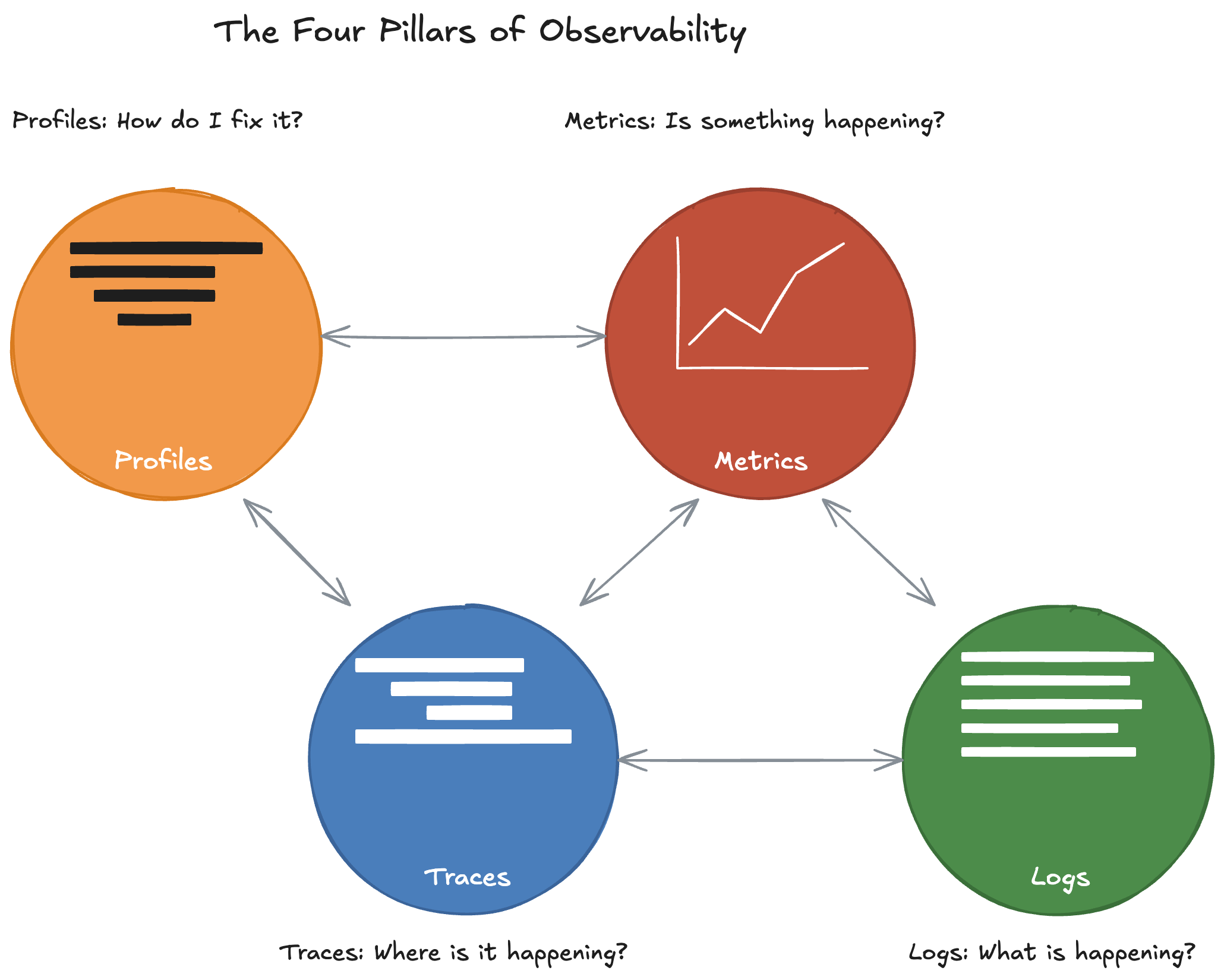
I'm keeping myself accountable by sharing my observability learnings, starting with the four pillars of observability.
What is observability?
When something goes wrong in a software system, you need a way to figure out what happened. Observability is the ability to understand what's going on inside a system by looking at what it puts out (its logs, metrics, traces, and profiles).
When something goes wrong in a software system, you need a way to figure out what happened. Observability is the ability to understand what's going on inside a system by looking at what it puts out (its logs, metrics, traces, and profiles).
People often break it down into four pillars:
- Metrics - "Is something happening?" Metrics are numbers over time: CPU usage, request latency, error rates. They're what you glance at on a dashboard to spot that something looks off.
- Logs - "What is happening?" Logs are detailed, timestamped records of individual events. For example, a request came in, a job failed, or a user logged in. Once metrics tell you something's wrong, logs tell you what actually happened.
- Traces - "Where is it happening?" Modern systems are made of many services talking to each other. A trace follows a single request as it hops from service to service, showing exactly where in that chain time was spent or where the failure occurred.
- Profiles - "How do I fix it?" Once you've narrowed the problem to a specific service or function, profiles show what the code was doing and which function and line were eating up CPU or memory.
On its own, they don't give you the full picture of your system so you have to correlate all of them together. Metrics tell you that something's wrong, logs and traces help you find where, and profiles help you understand why.

Marie Cruz
Senior Developer Advocate
she/her
Marie Cruz is a Software Tester with over 10 years of experience and the co-author of the book Contract Testing in Action. Currently, she works as a Senior Developer Advocate at Grafana Labs.
Sign in
to comment
Take this 7-question assessment to see where your QA team stands and get a plan for what to automate next.
Explore MoT
Complex workflows, flaky tests, fragmented tools, and AI-driven pressure are making it harder for QA teams to keep up.
Boost your career in software testing with the MoT Software Testing Essentials Certificate. Learn essential skills, from basic testing techniques to advanced risk analysis, crafted by industry experts.
Into the MoTaverse is a podcast by Ministry of Testing, hosted by Rosie Sherry, exploring the people, insights, and systems shaping quality in modern software teams.
