Why Quality teams are built on character, not just skills
What a darts team taught me about building high-performing quality teams
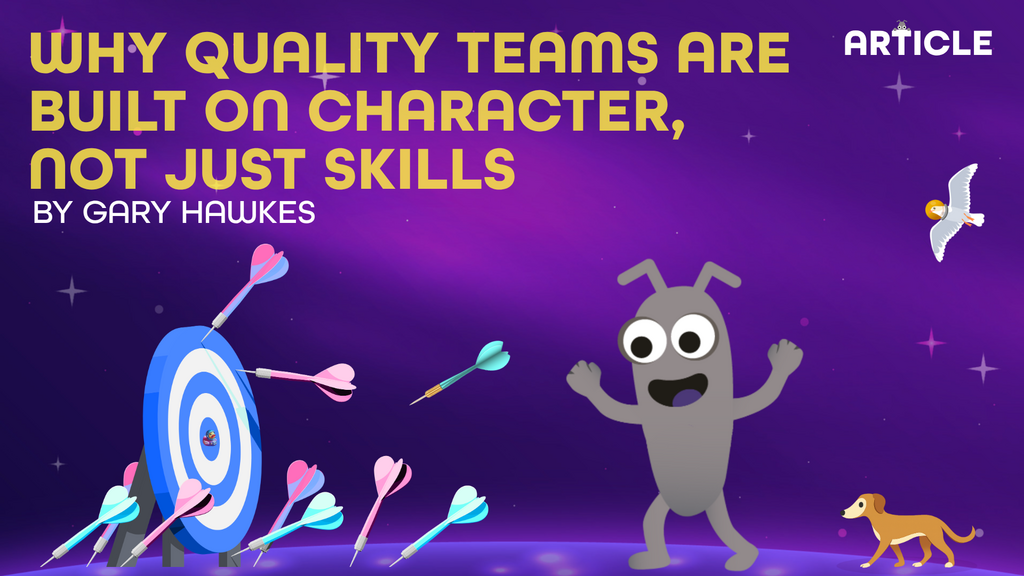
I captain a darts team. I know a strange way to start an article on building a Quality team, but hear me out. We weren’t the best, but we always overperformed, usually finishing 2nd or 3rd in the League. When we first joined, we won it two years in a row and then other teams strengthened. We stayed true to who we were, friends who enjoyed each other's company and met up each week to play darts.
For years, that kinship and support for each other had driven our success. Everyone on the team was a very different character who just clicked with the others. You knew who to turn to for a laugh, for advice, for motivation, for understanding, etc.
In the last few years, there were two friends who came along. One was a player, and the other was his best mate. If you know darts, he struggled with the “yips” meaning he had problems releasing the dart. He tried to fix it for years until ultimately, he decided to quit. Totally understandable, as I’d experienced the same problems but overcame them. Sadly, it's an awful feeling.
When he left, so did his best friend. After a few games, it was clear this was the worst we’d played as a team for a long time. We just didn’t understand. We’re the same players. How could we drop so much? We realised the root of it was that we’d lost two key characters of the team that linked us all together. That player loved cheering us on, even if he didn’t play well and was responsible for most of the banter. A lot of it was between him and his best friend, who used to have us in stitches. Whilst we’re all still very good friends, we’d lost a connection in the team that made us what we were. Our performance had gotten worse, and it was nothing to do with losing him as a dart player. It was losing him as a character.
I wanted to explore the similarities between that successful dart team and how building successful quality teams is no different. So I realised that what happened to my darts team was about a breakdown in our team chemistry. When I look back on this time, it draws parallels to building teams at work. To build successful, high-quality teams at work, you need to build teams with great chemistry. Personalities and characters that complement and connect with other members of the team, and where the sum of the parts is greater than the whole. So this article goes through my journey building such a team.
How we typically build teams
When I look back at my previous organisations, a lot of the focus when building teams revolved around skills and budget. The salary was usually fixed with very little wriggle room, if any. The new head would need to be approved, and to get that approval, you needed to be clear what role they were going to perform and their short-term plan of work. It was all about the skills and the workload.
I have made mistakes building teams with that as the focus. I had never built one from scratch. There were always people already there and it was more about growing the team to cover the work.
My initial mistake was my focus was on who I was recruiting, not so much on those already there. Interviews were skills-focused. Sure, you asked soft-skill questions in the interview, but if you needed an exploratory tester, you made sure you got a good one. If you needed an automated tester, you made sure you got a good one adhering to budgetary constraints.
However, what you missed over time was how well the team connected. If the connections and relationships didn’t happen organically, it became my job to try and enable that. Sometimes that could come through objectives. For example, ‘Work with person x to come with a proposal for y’. Sometimes that would work, sometimes it confirmed to the people in question that they didn’t really work well together. As the team got bigger you had a bigger job to do holding the team together. Some people would connect organically which was great, but some people didn’t.
My team building at ito
In each organisation I left as a leader, there was always at least one problem person I couldn’t help or connect with. It was never the sole reason I’d leave, but it was always an area I would look back on and ask myself, ‘What could I have done better?’. So when I joined Ito, with the mission of growing the team, I was going to take more care.
The test team
The test team was just two people. Whilst I was given instructions to recruit immediately, I wanted to spend more time with the two testers to understand not just what they did and their skill sets, but also their characters. Working with them, I realised they had grown up in an Engineering team that told them what to test, and they did exactly that. They hit their targets and tested what they were told to test, but ultimately they were waiting for their next instruction. They had reactive characters.
Recruiting a quality culture
So, whoever came into the team, they needed to influence them to think more proactively. Help them become more comfortable speaking up and have a say on how we improve. It couldn’t just be my job, like I had done in the past. I needed to create a culture in the Test team where each person grew collectively and was self-navigating. Whilst I clearly needed to balance the priority of recruiting the right skills at the right time, each person’s character was going to be just as important to create a team of people that would build a culture of quality and collaboration.
Sample characters
From then on, I built a team that grew from two Test Engineers to thirteen at its peak. For each person I added to the team, their character was just as important as their skills. For each recruit, I’d look at the team's characters and see which we needed so we would not only maintain the right balance but also bring in a new perspective.
Below, I’ve selected an anonymised sample of the engineers I recruited over the years to the team and have given them one word to describe their character and the benefits that character brought to the team.
Recruit 1: “Disciplined”
| Character Strengths | Character Weaknesses |
| Very process-driven. Confident in their methodology. Driven to succeed in their work and meet delivery targets. | Struggle with collaboration especially if methodologies questioned. Mentoring could sometimes be one way. |
Recruit 2: “Chilled”
| Character Strengths | Character Weaknesses |
| Calm when under pressure. A reassuring presence when working with others. | Not comfortable with difficult conversations. |
Recruit 3: “Innovator”
| Character Strengths | Character Weaknesses |
| Attitude of nothing was impossible, would embrace challenges. | Would be prickly to structure and process. Easily bored. |
Recruit 4: “Carer”
| Character Strengths | Character Weaknesses |
| Great listener and had a genuine need to understand people and help them. | Would be worried about upsetting people and could hold frustrations in as a result. |
Recruit 5: “Community”
| Character Strengths | Character Weaknesses |
| Stayed in touch with the industry and an active presence on social media for testing. Always looking to learn from others. | Could sometimes flit between techniques and tools without seeing them through to a conclusion. |
Recruit 6: “Expressive”
| Character Strengths | Character Weaknesses |
| Left no doubts in how they felt. Fun to work with and comfortable with being honest about their feelings 1-2-1. | Was very proud of their work rate and would use their expressiveness to convince others they were coping, when sometimes they weren’t. |
Recruit 7: “Studious”
| Character Strengths | Character Weaknesses |
| Loved learning, loved the profession and had loads of ideas 1-2-1. | Would sit behind more dominant characters and sometimes not speak up, when they had valid opinions. |
Building a quality culture
That's a sample of the characters I recruited! Each different character was a different piece of the puzzle to creating a culture of Quality. Some may have had the same skills, but each of them brought something different to the team.
My role was to celebrate their strengths. How I managed their weaknesses depended on whether those weaknesses were symptoms of other influences or embedded character traits. If they were symptoms of other influences, then I could help coach them to consider a different view and see opportunities for their growth. If they were embedded character traits, my role was to embrace those, not to change who people are. Instead, my position is to help people grow as they are.
So I let their character strengths influence me inside and outside the team, help where I can with their weaknesses, and respect people where I can’t. I didn’t put them in positions or scenarios where it’s just not who they are. There may be other characters better suited for those scenarios, or indeed it may be best sitting with you.
The benefits of recruiting different characters
Sharing the job of influencing
When focusing on recruiting skills to fill roles, as leader you make yourself the influencer. It becomes your job and not your team’s. Their influence becomes restricted to their day-to-day relationships. But the problem is that you have strengths and weaknesses in your character as well. Whilst your seniority will likely get you some influence, there will be areas of the business that you won’t be able to reach.
The power of all these different characters who see the world differently means you have amplified the influence you can have across the business. The “Innovator” will engage well with development engineers and even CTOs, generating a lot of interest in where your team is going technically. The “Chilled” can keep an air of calm with partnering organisations or customers you engage with when pressure gets high and timelines get tight. The “Disciplined” can work on projects where compliance with standards is a must, as they’ll be all over the details and give stakeholders confidence that we know where we’re going.
If as a leader, you allow your team to express themselves openly, their influence will be internal, external, up the hierarchy, down and across the organisation.
Creating a diverse team
A wonderful byproduct of focusing on characters is I created the most diverse team I’ve ever worked with. Just looking for diverse characters got me diverse people. So at its peak, my team had a broad representation ranging from men, women, LGBTQ+, Black, White, and people from different nationalities, religions and cultures.
It brought a power to the team for testing I’d never experienced. A vast array of life experiences and perspectives that educated and influenced products, colleagues, stakeholders, and, of course, me.
Flexibility in approaching projects and tasks
Whether it be the product, team, or stakeholders that make them different, each project has an array of unique attributes that suit the qualities of different team members.
For example, one project may need an “Expressive” character’s honesty to help identify basics that were missed or the need for more information. Another may need a “Studious” figure who could investigate problems and find ways to make things more efficient.
All play a part in making projects smoother, more streamlined and with higher quality.
Creating an inclusive progression model
For progression, there are two camps. Line Managers and Tech Experts.
For Line Managers, if you need to restructure the team, you know who would have the potential to be great people managers. You’ll also have an idea on who would be an ideal fit for their team. Having a “Caring” character is ideal as they’ll make the success of the people in their team first and do everything they can to support their growth. Having “Community” characters in Line Management will mean they will bring something new to their teams, keeping people excited and learning.
For Tech Experts, you’ll be able to see those characters who want to focus on extending their skills and taking on greater responsibility in areas of technical specialism. For those “Studious”, “Innovative” and “Disciplined” characters, Line Management is likely to be an area they don’t want to go.
Encouraging healthy conflict
There are times when these characters need to work together, regardless of whether their characters gel. Whilst that can be a negative, as a leader, it’s very powerful. A perfect example is that the “Innovative” may want to try new things, embrace technology, and have the freedom to explore, whereas the “Disciplined” can be rigid in their approach and sure of their methodology.
Getting them both to collaborate on a project and come up with a joined-up approach is not impossible, but unlikely. And if they must work together, you, as the leader, may need to be the bridge between them to help them understand each other’s views. That way, you can coach them to appreciate an opportunity to synergise.
Creating a team that evolves through synergy
This is the most important benefit that comes with a diverse team. With a team of diverse characters and perspectives, the whole is truly greater than the sum of its parts. Every individual will have ideas based on their own perspective. On their own, they may stand up to scrutiny. However, the power comes from other perspectives that may not be being considered.
When those discussions happen, it’s an awesome feeling, but as the leader your goal is simple. Ensure those perspectives are understood and respected, then guide the conversation to collectively develop ideas and solutions that are better and more complete than any individual could bring to the team.
To wrap up
When building a team, yes, you need skills. You’ll have jobs to do and project teams to resource. But if you focus solely on skills, as the work and company grow, you’ll get the job done, but your job as a leader will get more difficult.
Influencing, understanding diversity, and finding flexibility become your responsibility, not an organic feature of your team. Progression is hard work as you’ll be reacting to clashes, disappointed team members and characters in the wrong roles.
As you grow your team, ask yourself what characters you need, then what skills. As each hire comes in, reassess. What characters do I need now and how will they fit with my other characters? What traits will they bring to the team that you don’t have yet?
The power and influence of your team will be multi-linear, influencing the organisation, people, and products, and encouraging growth and understanding. Your whole team will play an equal part in its success, including you.
What do YOU think?
Have comments or thoughts? Share them in the comments box below. If you like, use the ideas below as starting points for reflection and discussion.
- What characters have you worked with?
- What did they bring beyond their hard skills?
- How did they influence you and the way you saw the world?
- How do you see your character fitting in with the others on your teams?
- What do you bring as a result?

Head of Engineering who came from QE. Admirer of all humans (with a special affinity for testers). I love to bring out the best in people and help them grow. I have a very tactical view of delivery and love working to find the sweet spot so that processes are balance between effort and value,
Comments