

Two MoTacon attendees are on the left. The MoTaacon logo is in the center, and to the right a prompt to Get Your Ticket.
What's the hardest part of defining "expected behaviour" for a system that produces different output every time? image
  • Piotr Wicherski's profile image
  • Simon Tomes's profile image
  • Oleksandr Romanov's profile image
  • Lauren Lassey's profile image
  • Jesse Berkeley's profile image
  • James Pearce's profile image
  • Adam Davis's profile image
  • Demi Van Malcot's profile image
When a system improvises like a jazz soloist, "different" stops meaning "wrong"

Hot, flaky, and unfinished - Testing, accessibility, and the grief we don't talk about - Ep 137 image
  • Simon Tomes's profile image
  • Ady Stokes's profile image
  • Oleksandr Romanov's profile image
  • Clare Norman's profile image
  • Judy Mosley's profile image
Judy and Clare trade spicy hot takes, from notification overload and 'done > perfect' learning, to a passionate deep dive on accessibility as a moral (and business) imperative.
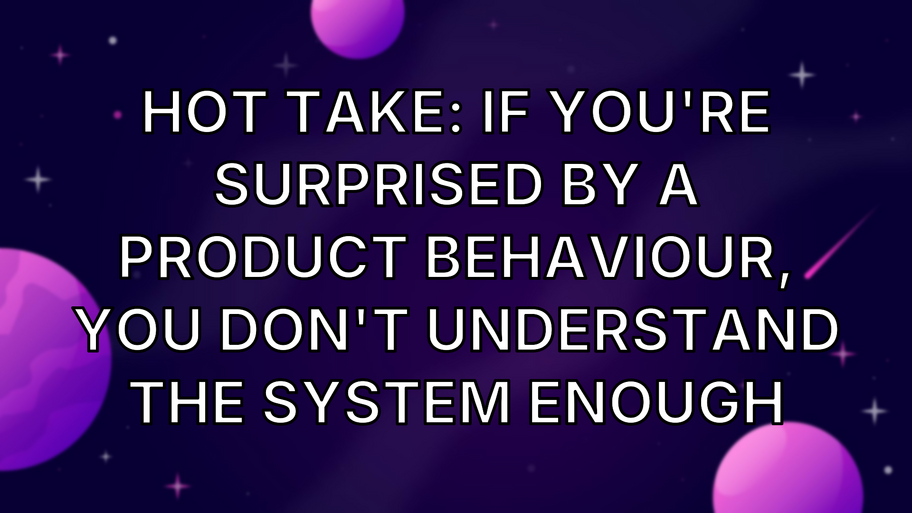
Hot take: if you're surprised by a product behaviour, you don't understand the system enough image
  • Oleksandr Romanov's profile image
  • TWiQ — This Week in Quality's profile image
Oleksandr said: My hot take of the week: If you don't fully understand the thing you want to test and measure - you might get the results that are surprising but yet mysterious. So - first - unders...
Test Everything Twice (TET) image
  • Oleksandr Romanov's profile image
A playful backronym coined live in the TWiQ chat as a testing-world companion to the DRY/WET family of terms, standing for "Test Everything Twice." as a counterpart to WET (Write Everything Twice), it captures the idea of deliberate, thorough verification rather than assuming a single test pass is sufficient. Like WET and DRY, it works best as a conversational shorthand for a mindset rather than a strict rule.
My insights from "The Hidden Cost of AI Coding That's Destroying Engineering Teams" image
  • AI Chapter's profile image
Yesterday, I found an interesting video about the reality of using AI in software teams. The title is "The Hidden Cost of AI Coding That's Destroying Engineering Teams." Top insights 💡 We know...
Ikigai image
  • Oleksandr Romanov's profile image
Ikigai (生き甲斐, lit. 'a reason for being') is a Japanese concept of an individual's definition of the meaning of their life.Héctor García and Francesc Miralles included a Venn diagram of Ikigai in their book: "Ikigai: The Japanese Secret to a Long and Happy Life". This diagram includes four elements: what a person likes, what a person is good at, what the world needs, and what can be rewarded. When these four elements overlap, that person has found their ikigai.
Today in AI, I learned that ... the usage of AI can make dysfunctional organizations and processes even worse. image
Top 5 things: The more people use AI, the less they tend to ... think and connect to their work. AI tools can ... hurt trust within colleagues. AI tools can ... state factually wrong things even m...
Subscribe to our newsletter