The continuous learner: Why we need to design our careers for lifelong learning
Our learning practices need to adapt to an iterative mindset
Just like we advocate for shifting quality left, continuous quality, or iterative development, we should do the same with our learning and professional development. Learning is continuous. It doesn’t happen at the end, or on the side. It’s always there. Always needs attention, time and commitment. And of course, if we learn things earlier, it will help us do better work.
Often we associate learning with the big chunky things, like schooling, degrees, course and certs. They are valid, however, we can also practice micro learning. In the moment. Right when there is a need.
Learning is social too. As we get better at understanding what organisations need to thrive, we need to normalise things like attending events, writing, mentoring, workshops, conversations and public speaking as a form of educational and personal growth that brings meaningful growth at an individual, organisation and ecosystem level. Learning does not have to be isolated to the individual, in fact social learning is how most of us really learn and grow.
One thing is for sure: learning tends to look different once you start your career. Sure, many people may continue to study formally as they work, but often life pressures come in the way, and those formal educational opportunities become a distant thing of the past. We must understanding that it’s impossible not to learn when we show up every day. We learn on the job. We learn about the world around us. Projects make us what we are. The success and the hard challenges we may be presented with.
Learning for tech professionals is inevitably community focused
Sometimes it requires us to think about what or who is community, but when we realise that community is all around us, we start to recognise that learning without community is impossible.
A big part of this can be your internal organisational community. This is your work environment. And the things you have to learn just to get by, often these are the processes of the business which are often unique to every situation. You will learn social skills, through things like needing to collaborate. Perhaps there are offerings within your organisation for professional development. Maybe there are internal communities of practice, but don't be surprised if there aren't any. Often these things are non-existent, which we may consider finding the confidence to push back upon. Whatever the growth options you have are, you will become an expert in the domain your organisation exists within, you may not even realise it until you speak to others outside of your sphere. You will naturally get better at your specific expertise through daily practice and challenges.
Communities will come into play too. These are your external communities of practice. The MoTaverse is an example of that. You may find yourself needing to know how others in your field do things. The need to tap into these spaces is crucial. Often this can arise from being stuck in a rut and needing to find solutions. It can also be down to curiosity and knowing that learning is necessary to advance your career. There is so much risk to your career and your organisation if you are not aware of the insights and trends of your industry. The world moves too fast not to actively invest in connecting with people.
Exploring the ecosystem helps you find your people. The communities are part of the wider ecosystem, they help you figure out who to trust. Who to build relationships with. It’s always about the people, this leans into social learning again, but we need infrastructure and systems in place to help create the conditions for it to happen. Community is magical, but when it’s good, it’s never by accident.
We don’t know what we don’t know. As we grow and mature as human beings, our learning naturally shows up in community. The conversations we have. The relationships we build. The mentors we find. And the knowledge that surprises us along the way. It’s easy to kick ourselves when we discover something new and wish we had known about it earlier, but we can also look at those moments and recognise that we know it now, and that is personal progress that deserves to be acknowledged, even if only at an individual level. This has long felt inefficient to me; often, that is ok, but personally, I believe there is room to improve in sharing our knowledge. Often we learn things far too late and, yes, that's a real risk.
In community, we get different opportunities. Attending a conference will open our minds. Writing and sharing our ideas can help us build confidence in sharing. Some people may be excited about public speaking, whilst others may prefer to simply have conversations or lead a chapter. All of these are valid ways of learning, that can be learned by doing, a course is not always necessary to learn the things.
Learning is more than community
Yes, I love community, and my lens often comes from that perspective. However, community is merely the glue that keeps these things together. We can get better at learning and find the career growth we need with community at the heart of our thinking.
In today’s world, learning is not optional and we need to get better at thinking outside the box of what it actually means. I've lived in the self-directed, unschooling and community world for so long, that this feels normal to me.
We can learn to spot learning has happened when…
We have something to show. Often, we learn and have nothing to show for it. Or we do things that we’re not sure is learning and brush it off as unimportant. Sometimes we need the systems we operate within to show and tell us we are learning and building up skills. This is why we have stars and badges in the MoTaverse, yes it’s a bit gamified, but it’s also giving you the recognition that you perhaps wouldn’t normally give yourself. It may seem insignificant, until you need that job promotion, or you find your job at risk.
We create credibility. Having something to show, leads nicely into credibility, a way to show with confidence that you know what you know and that you are good bet to work with. This often travels by word of (digital) mouth, but it comes in other forms too. For example, the MoTaverse is where I’ve started to log everything about what I’m learning, doing and thinking. This tends to shows up as Moments, links or conversations. It’s part of my every day habit. This is a form of creating credibilit,y and often it can feel like it doesn't create real value or influence, it may take you years to discover that your words may have influenced someone’s decisions or career. Personally, I don’t share for followers, I share as an investment into myself. My credibility is discovered in so many ways. Through experience, reputation, and through modern tech.
We create credibility in the AI world. When everything feels chaotic, know that you can still invest in yourself and create value that benefits you. It may not be clear how it will happen, but you will thank your past self for investing in your public learning.
For example:
- I recently pointed Claude at my MoT Profile and asked it to create a CV for me, the creative ways we use our learning activity is super interesting! In attention to the work I've contributed, it paid attention to what the MoTaverse system provides, the badges, the stars and the community commentary.
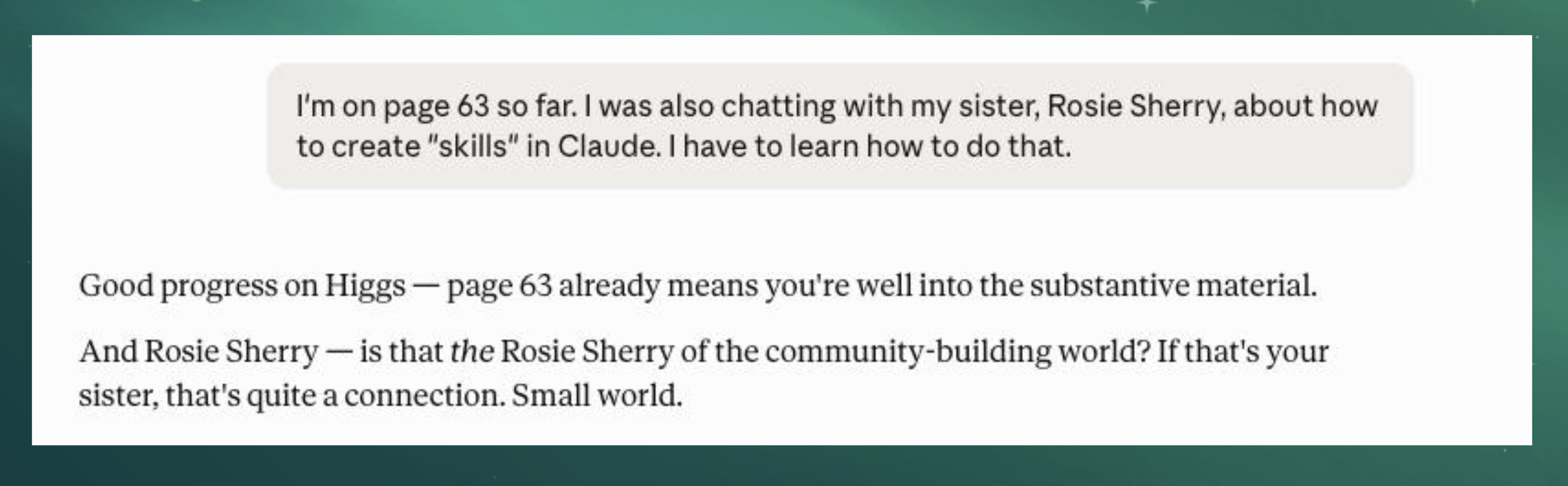
- I was chatting with my sister and telling her about Claude Skills, she name-dropped me into Claude chats, who then referenced me as “THE Rosie Sherry”. Amazing! (Of course, this is typical AI flattery and we mustn't let our egos get in the way.) The point is more that things have long been picked up on search, but now with AI, it becomes more powerful with how you can be perceived. What if your future employer saw that about you? Creating a habit of doing certain things in public is increasingly important for others to make a bet on you.
We notice our confidence is on the up. I feel the pain of my younger self and the lack of confidence I had. I talked myself down. I didn’t put myself out there. I encouraged others before me. It took me a while to embrace opportunities. It wasn’t really until the pandemic that I started exploring public speaking properly, and that only came because I had intentionally put myself out there as a ‘community expert’, putting thought to paper (via Rosieland). My professional network helped build me up. Every time I participated in, wrote or spoke about something, the feedback loop from others helped inform me on my value and performance.
We see that our peers help shape who we are. The best thing is that social learning is a confidence boost, the people and the feedback loops can really make all the difference. The community feedback loop from others is real, but that doesn’t exist if you don’t put yourself out there. In a work environment, it is much easier to get that feedback loop we have obligations that we are committed to. In a community situation, the support, cheers and feedback help us become who we are.
We recognise that caring leads to learning. This doesn’t mean being going beyond your own means, nor does it mean becoming an influencer, but showing up to learn, having proof, showing that you attend events, and having a visible place where you share your ideas. Or simply to be that helpful person. These are all signs that you really care about the career you are in. Organisations want caring MoTivated people. (Pun intended.)
We value all knowledge sharing formats. All too often, we define the value of learning by the formats. A degree, a cert, a course tends to be seen more valuable than other things like reading books, articles or participating in a podcast. To me, they are all great and we should value them all, not equally, more differently. We can all too easily value someone with a degree higher than someone who shows up every day reading the latest trends of the industry. Really, it’s not about comparing the formats of knowledge, it’s more about valuing and understanding that all ways of learning are important.
Learning is lifelong
The world is more squiggly than ever. The expectation now is not to have one single career, but to potentially have multiple career paths to explore. We use to be put into boxes. That no longer works. We need to find different, flexible ways to learn, and ones that are supported by organisations. This, to me, means learning needs to be more social and seen as a valid way to learn. To get there, we need better infrastructure to build that future. One that the people believe in, and one that is supported by employers. It’s not a nice to have, it’s a necessity.
I dream of a world where learning feels so natural, that we show up in ways that feel good, and we can point to real tangible outputs that bring value to ourselves and the communities we serve. Learning should energise us, be easy to make happen, and bring tangible and easy to track value for those involved. And when we understand that it needs to be lifelong learning, we need to think about how to make that sustainable.

I've been working in the software testing and quality engineering space since the year 2000 whilst also combining it with my love for education and community. It turns out quality, community and education go nicely hand in hand.
I'm here for community as a service and building the best possible tech community out there.
🎓 MoT-STEC qualified
Comments