
Footholds, not answers: What the AI Learning Companion taught me about itself
10 Jul 2026
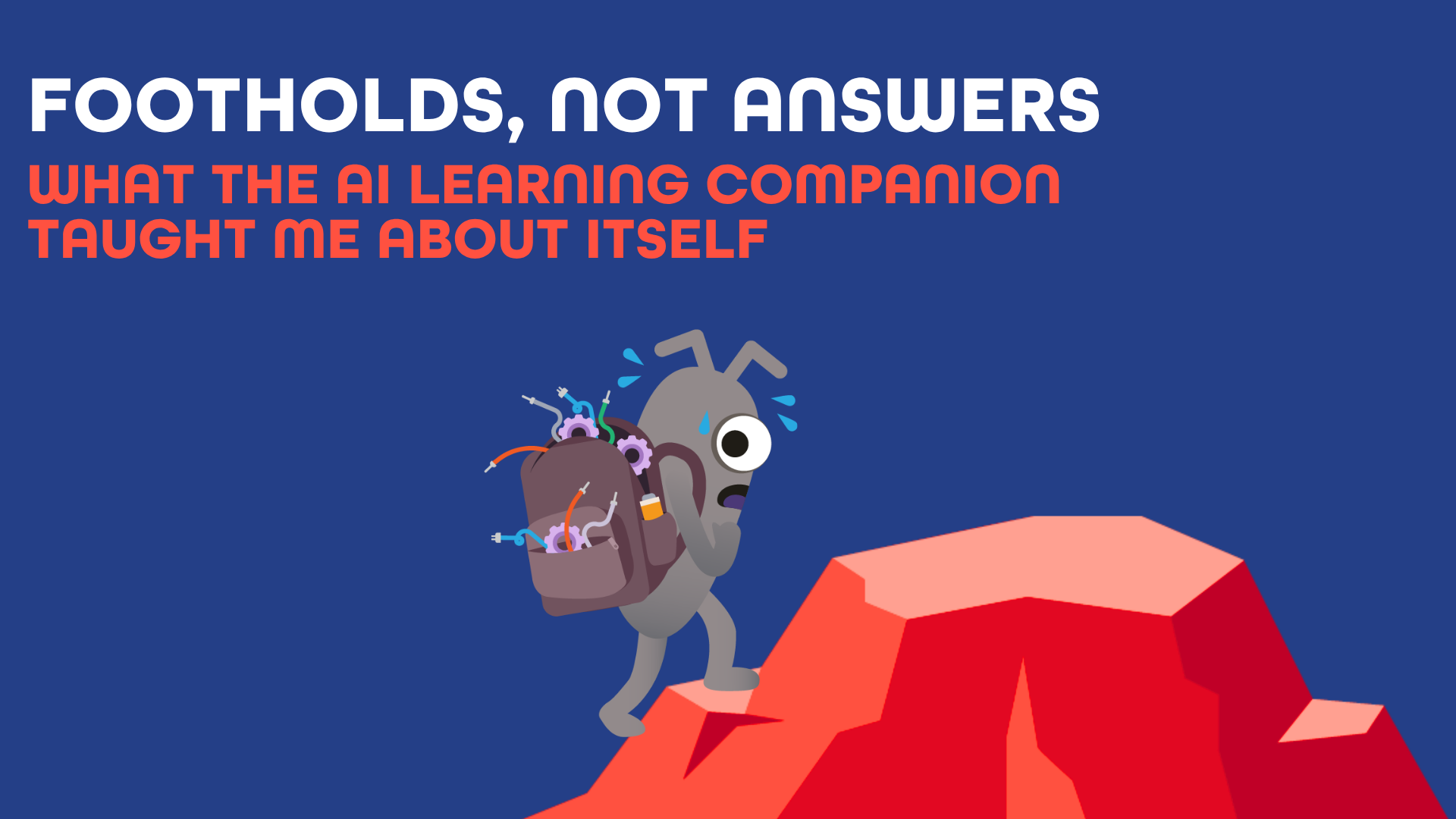
Last week, I shared the Learning Companion skill with the community. This week, I turned it on the paper that inspired it.
I’d been testing the companion skill against different pieces of quality and testing content to check whether the output was useful. This time, I wanted to see how it held up when I picked something outside that domain, something I already knew well: the paper that started all of this.
I’d been testing the companion skill against different pieces of quality and testing content to check whether the output was useful. This time, I wanted to see how it held up when I picked something outside that domain, something I already knew well: the paper that started all of this.
The quiet cost of getting faster
That paper's central argument is one I think a lot of people working in tech will recognise: Most AI tools weren’t built to improve your capability. They were built to increase throughput. The logic that makes them useful at work (like optimise the output, minimise effort, treat each interaction as disposable) is exactly what makes them risky as tools for durable learning and growth.
Likewise, most of the AI tools we use, such as test generation and code assistants, are built to get the task done faster. That's not a criticism; I use AI tools this way too. But there's a quieter cost: the muscle you don't use is the muscle that atrophies. If you ask an AI to generate your test cases every time, the thing that quietly stops developing might be your own eye for what's worth testing.
So when I sat down to test my own AI learning tool, I wanted to know if it was doing what it was designed to do; Was it helping me build something in my own thinking, or was it just helping me get through the material faster?
The experiment I didn't expect
I fed the paper in and worked through the companion's usual output: key ideas, reflection prompts. It felt useful, but fairly passive, until I reached the “Practical Next Steps and Experiments” section. That's where it stopped being routine. The companion said:
"Try this — Re-read Section 5 of learning-companion against 'errors as diagnostic data, not failures to correct' and 'faded scaffolding, not more support over time.' Check whether the current starter sentences assume the learner already has something to say, or whether there's room for someone who's stuck to signal that without the skill jumping in to solve it for them."
"Try this — Re-read Section 5 of learning-companion against 'errors as diagnostic data, not failures to correct' and 'faded scaffolding, not more support over time.' Check whether the current starter sentences assume the learner already has something to say, or whether there's room for someone who's stuck to signal that without the skill jumping in to solve it for them."
It had remembered that I'd created the Learning Companion. Not just remembered the fact of it; but used that history to hand me something specific to check my own skill against, using the paper's key takeaways.
Starting a reflective session using a resource is handy but starting one where the tool already knows what you previously did then points you somewhere to take that learning further is a different level of useful. This output gave me enough of a foothold to start running the experiment and answering the reflective questions.
Starting a reflective session using a resource is handy but starting one where the tool already knows what you previously did then points you somewhere to take that learning further is a different level of useful. This output gave me enough of a foothold to start running the experiment and answering the reflective questions.
Footholds, not answers
So I did what it asked. I went back to Section 5 of the skill and read it against those two ideas: errors as diagnostic data, and faded scaffolding.
Section 5 is the part of the Learning Companion that helps someone capture their learning. It deliberately does not write a reflection for them. It offers starter sentences instead, so the learner still has to decide what they think and put it into their own words. That still feels like the right choice. I don’t want the skill to create a polished reflection that someone can copy and paste. I want it to help someone notice what they think and why.
Section 5 is the part of the Learning Companion that helps someone capture their learning. It deliberately does not write a reflection for them. It offers starter sentences instead, so the learner still has to decide what they think and put it into their own words. That still feels like the right choice. I don’t want the skill to create a polished reflection that someone can copy and paste. I want it to help someone notice what they think and why.
But what the experiment helped me see is that the starter sentences are not the whole support. They are the foothold. They give you enough to notice which direction you might want to explore, and because this is happening in Claude, you can keep going. You can pick one starter and say, “This is the bit I’m interested in, where could I take it?” or “I think there’s something in this, but I can’t quite get to it yet.”
That back-and-forth is useful, that helped my thinking become clearer. This is what helped me answer the question I started with: “ Was the skill helping me build something in my own thinking, or was it just helping me get through the material faster?” I think the skill was helping me build something in my own thinking by giving me a place to start, then the LLM let me push further where I needed to.
So the Learning Companion is not perfect. It was good in that moment, but it won’t fade its support over time, and it won’t track my errors as diagnostic data across sessions in the way the paper describes. That would require a different kind of tool and architecture, one built around a learner’s memory over time, not just a single conversation.
That is a bigger problem than one skill can solve on its own. But there is something I can do right now, without waiting for that architecture to exist: build my own record of what I’ve learned.
Your own learning history, written down
If the Learning Companion can't yet remember me reliably across sessions, I can still create a record by writing down what I noticed, what I tried, and what I’d do differently next time as a Moment. A Moment is more than sharing what you know. It is evidence of your learning and growth.
As AI support for learning becomes more advanced, a blank chat is not going to be enough. It needs some kind of learner history to work from: what you explored, what you tried, where you got stuck, what changed, and what you might need support with next. Moments could be part of that.
The Learning Companion already nudges you here; its reflection prompts point you toward writing up what you tried and what you learned as a Moment. But it doesn't help you shape that into something worth publishing, and that is why the moment-creator skill now exists.
You can download the memory-creator.skill here
Start yours
The Learning Companion gave me a foothold to think deeply and experiment. The Moment Creator helped me write this Moment, and gave me evidence of what I noticed, what I tried, and what I’d do differently next time. That’s true for anyone who tries using them.
If you haven’t given the Learning Learning Companion a go yet, that’s the place to start. And if you’ve already got something to reflect on but aren’t sure how to shape it into a Moment, the Moment Creator can help you get it written.
If you haven’t given the Learning Learning Companion a go yet, that’s the place to start. And if you’ve already got something to reflect on but aren’t sure how to shape it into a Moment, the Moment Creator can help you get it written.

Sarah Deery
Learning and Development Lead
She/Her
My main aim is to help quality professionals turn their vast knowledge and skills into bite-sized chunks that the community can digest.
Sign in
to comment
Take this 7-question assessment to see where your QA team stands and get a plan for what to automate next.
Explore MoT
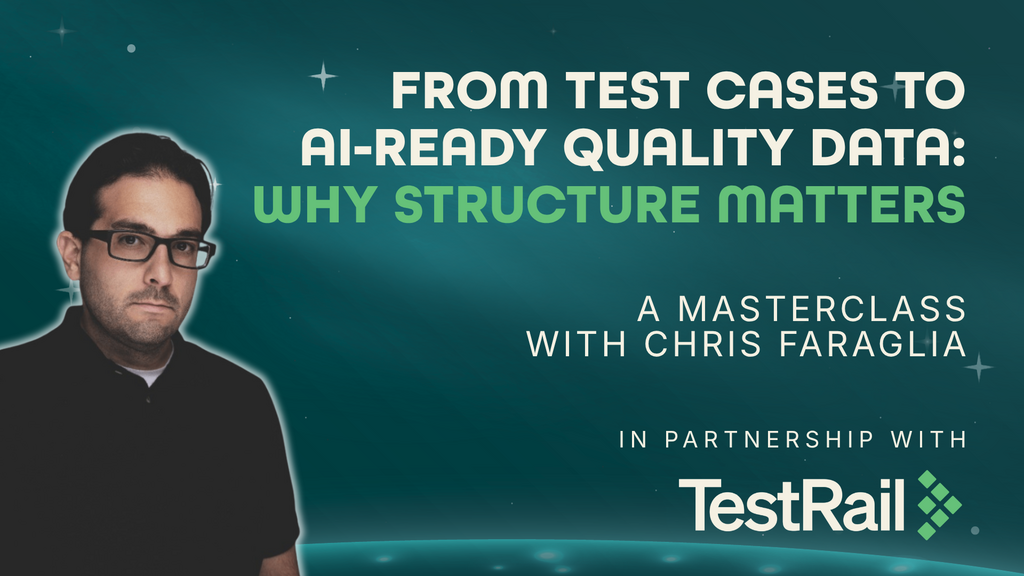
Learn how to structure and organize test management data as an AI-ready foundation that gives AI systems richer context for testing insights and workflows.
Boost your career in software testing with the MoT Software Testing Essentials Certificate. Learn essential skills, from basic testing techniques to advanced risk analysis, crafted by industry experts.
Into the MoTaverse is a podcast by Ministry of Testing, hosted by Rosie Sherry, exploring the people, insights, and systems shaping quality in modern software teams.
