In The Observatory, the MoTaverse community shows up to share links they are reading all the time.
The value is not only in the links shared in the moment, but also in the accumulation of links that become searchable knowledge over time.
There are currently 2907 searchable links.
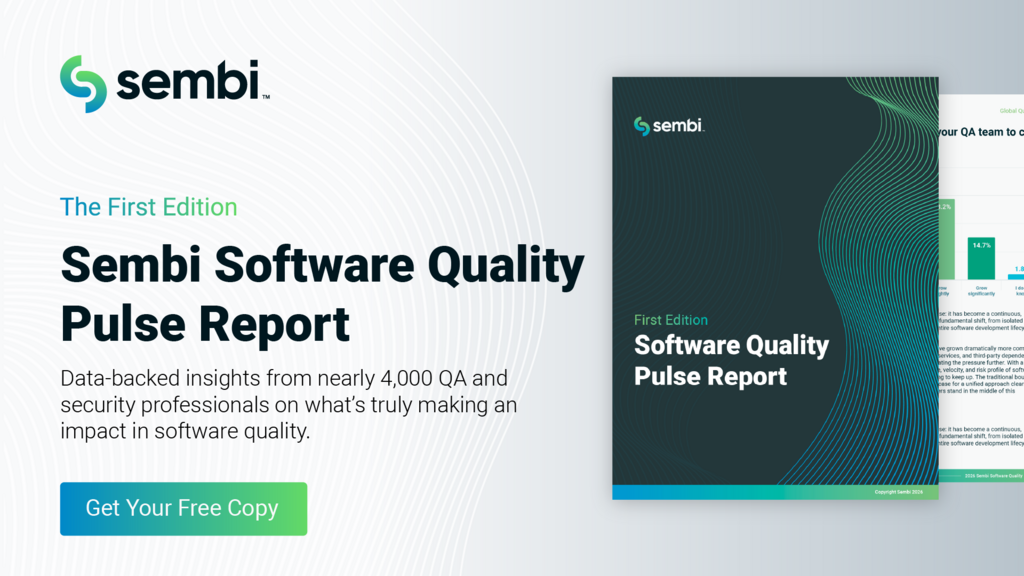
The Sembi Software Quality Pulse Report is Here
How are teams like yours balancing speed, quality, security, and AI in 2026? Download your copy and get real insights.
🎉 Featured link of the week:
Quality Management System has the same parts but how it is operating is changing — Melissa Fisher
I’m working on my thinking for a Quality Management System workshop I am doing in under 2 months. As part of this I can’t help but think about how to make it relevant to the changes AI is having to this and what questions might be sent my way. So this blog post is working through meandering thoughts. Figuring things out as I go.
10 links from the Observatory this week:
Job Hunt With a Bot? — Debbie O'Brien
I created a Job Hunt bot on Grok Bot. Literally just created it with the name job hunt. It answered back. Hey Debbie, I am here for the job hunt. Roles, companies, applications, the whole pipeline. What are you looking for right now. A specific role, a company you want in on, or more of a wide net.
Testing for Disruption🎉 — Jesper Ottosen
Often the testing mindset is mistaken for a disruptive and hacking mindset, while it can be beneficial to explore a system critically the general system owner would prefer avoiding service disruptions. In large enterprise and public services systems the system owners often prefer and sponsor that it’s tested that the solution can indeed withstand and recover from disruptions.
The hidden complexity of input fields: All the questions I ask before I trust it — Lindsay Weir-Mui | WonderProxy
Text boxes and input fields are everywhere in webpages and applications. They seem innocuous. After all, how could something as simple as a box where a user types text cause problems? But mix a simple element like this with human beings, and it's another story. These little boxes can be a challenge to test and a place where bugs lurk.
Control and complexity: tension in systems design — Fred Hebert
The adoption of LLMs in software development has led countless organizations to rapidly change their practices and structures. Old methods are questioned, replaced, and repurposed as the economics around creating new code get shaken up. Because humans and LLMs aren’t interchangeable, the dynamics in play are also very different. Systems are systems, and so regardless of what is changing, there are known patterns on which we can draw to provide some guidance and warnings.
The AI Organization, part I — Omar Shams
If your job involves coding or writing, change is coming: Large Language Models (LLMs) will change the way you work, and it may happen very quickly.
The consensus opinion now is that LLMs are going to be as important as the printing press1 or perhaps even the Industrial Revolution. Some are even saying it’s the end of the world as we know it.
Two METR staff members (Hjalmar Wijk and Ajeya Cotra) and a Redwood Research staff member contracting with METR (Ryan Greenblatt) worked on premises at OpenAI over a total of six days to attempt to form an independent understanding of model behavior observed during the recent incident in which OpenAI agents coordinated a multi-day hack of Hugging Face on a shared unsanctioned “message board.”
And, not But — Alan Page
a one word fix for leaders who split the truth
When social platforms reward reaction, blogging rewards reflection — Alexandre Lion
Every time I open X, Threads, or Bluesky, I see people battling to get the most reach, likes, and interactions.
So they are sharing horrible takes, creating drama, spreading fake news, or just pretending. Those are the louder and noisier people in the room.
The wiser, more knowledgeable, interesting, and genuine ones, or those who don’t want to play this game, are muted, skipped by the algorithm or just too busy to post online.
Building an agentic SDLC with a QA engineering mindset — StackOverflow
Ryan welcomes Suneet Malhotra, Senior Manager of Test Engineering at Motorola Solutions, to chat about building end-to-end agentic SDLC pipelines using MCPs, using Cohen’s kappa to evaluate multiple LLMs-as-judges, and how you can improve requirements by shifting QA left through a specification enrichment stage immediately after the design phase.
How AI Is Changing Open Source — Jiri Eischmann
AI entered software development at full speed this year, and it is significantly impacting open-source projects as well. In this article, I discuss several trends I have recently observed in open source in connection with AI, and how these trends are changing the world of open-source software.
Explore all Observatory links…
SmartBear BearQ launched - Start free trial!
BearQ continuously tests your app, reducing test maintenance and uncovering gaps scripted tests can miss.