How to create a test strategy (with template and worked examples)
Every quality product needs a great test strategy

A test strategy is a means of informing what your testing will look like. A test strategy will detail the approaches that you'll use, the structure of your testing, how you will report on your testing, any sources of oracles or heuristics that help drive your testing, and how you actually plan to execute your testing. A good test strategy evolves as a team and their approach to software delivery evolves.
How might you format a test strategy?
Test strategies are often perceived to be a document, however, they can come in many formats. A test strategy can be drawn as models such as a mind map or diagram, written up as a single page strategy that provides a dashboard summary, or more commonly be written as a document with different subsections detailing different activities.
You can build one in eight steps, from context to sign-off. It is not a test plan. The strategy describes how you test across projects, while a plan says what, when, and who for a single release. Choose a format that best suits your context.
- Context first: your product, users, architecture, and regulations shape every later decision.
- Goals you can measure: replace "ensure quality" with targets like "95% of payment bugs caught before release."
- Risks drive coverage: score likelihood and impact, then map each top risk to a test level.
- Keep it short: 2 to 5 pages, reviewed regularly, with a named person who approves it.
Your team ships every two weeks. Something breaks in production the same way it did last month. The fix is usually not more test cases. It is a shared answer to "how do we test here, and why?" That answer is a test strategy. This guide walks you through writing one your team will actually read and use.
What a test strategy is (and what it is not)
A test strategy is your team's standing answer to a set of questions. What does quality mean for this product? Which risks worry us most? Which levels of testing do we rely on, and what happens when a defect escapes? It applies across projects and changes slowly.
It outlines the testing approach a company takes across its software development life cycle. In practice, the most useful strategies are short and concise. Two to five pages, or to be consumed in a short period of time. Enough to align decisions, not enough to become shelf-ware.
What it is not: a list of test cases, a tool purchase decision, or a document nobody opens after onboarding week. If your strategy mostly restates a template you found online, it is not doing its job.
Test strategy vs test plan: the difference that matters
The confusion between these two terms drives a lot of searches, and a lot of messy documents. Keep it simple:
- Test strategy: how we test as a team, across projects.
- Test plan: what, when, and who for one project or release.
| Test strategy | Test plan | |
|---|---|---|
| Question it answers | How do we test as a team? | What do we test in this release? |
| Applies to | All projects or one product line | One project or release |
| Typical owner | QA or test lead | Test lead or an assigned tester |
| How often it changes | Rarely; reviewed quarterly or twice a year | Every release or sprint |
| Typical length | 2 to 5 pages | Varies with the release |
Every good test plan should sit inside the strategy, not fight it. If you work on a single small project, you may not need a strategy at all. A one-page test plan can carry the weight. Write a strategy when you keep re-litigating the same decisions across projects: which environments to cover, how much to automate, who signs off a release.
When you need one, and when a lighter approach works
Signals that you need a real strategy:
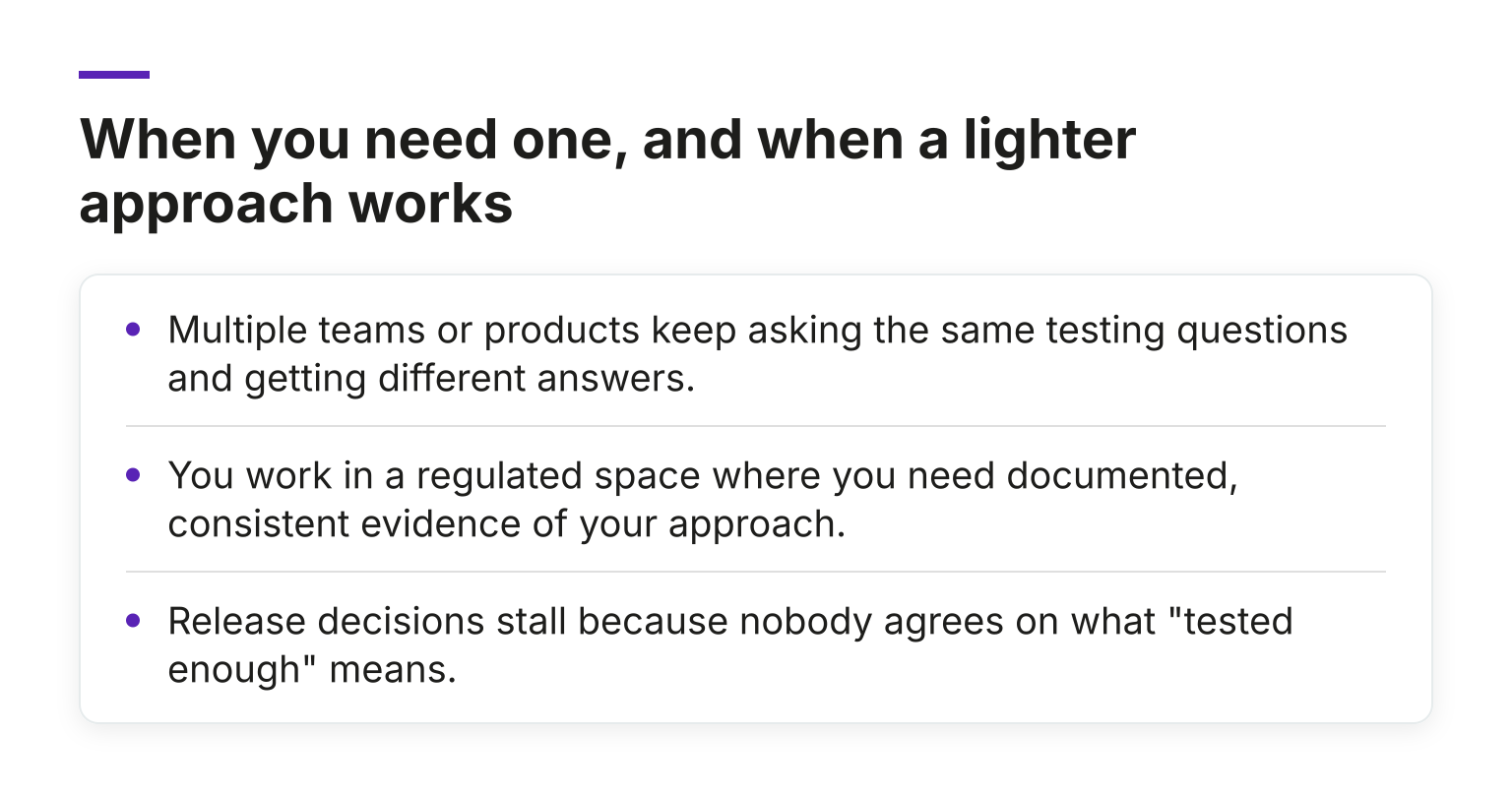
- Multiple teams or products keep asking the same testing questions and getting different answers.
- You work in a regulated space where you need documented, consistent evidence of your approach.
- Release decisions stall because nobody agrees on what "tested enough" means.
Signals that a lighter approach is fine: one team, one product, short releases, and a small set of shared norms you already follow without writing them down. In that case, a one-page test plan plus a good team culture beats a strategy document nobody reads. Start light. Add the strategy when the same arguments show up three times.
Step 1: Start with context, not the template
Before you write a word of strategy, write down your context. Answer these questions:
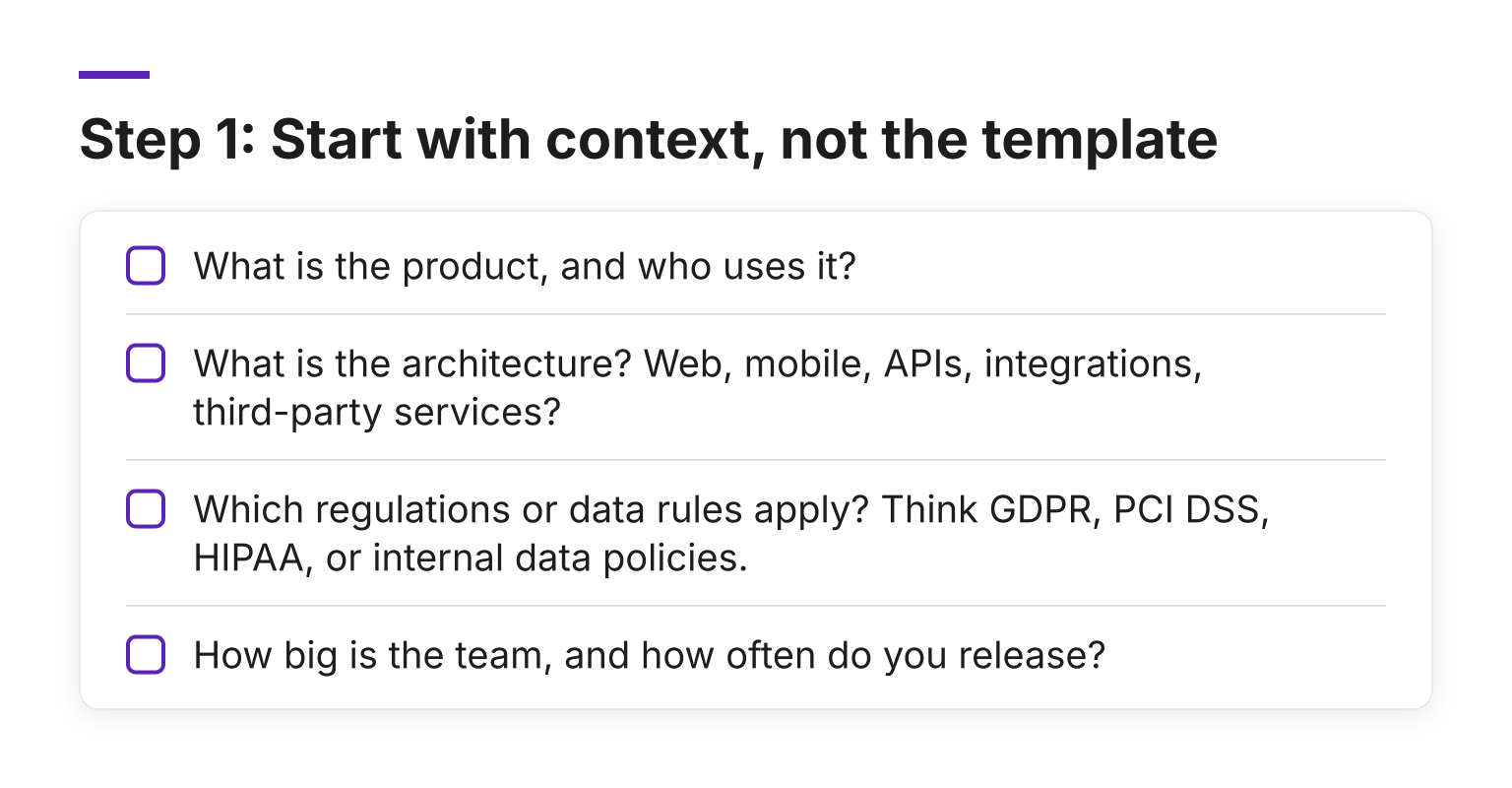
- What is the product, and who uses it?
- What is the architecture? Web, mobile, APIs, integrations, third-party services?
- Which regulations or data rules apply? Think GDPR, PCI DSS, HIPAA, or internal data policies.
- How big is the team, and how often do you release?
Mini example: "We test a payments web app with a five-person engineering team. The product processes card data, so PCI DSS applies. Users reach it mostly on Chrome and Safari, and we ship every two weeks."
Those four sentences already shape your scope, your environments, and your sign-off. Every later step hangs off this context.
Step 2: Set objectives and quality goals you can measure
"Ensure quality" is not a goal. It is a wish. Write objectives that a teammate could check, following the SMART pattern: specific, measurable, achievable, relevant, and time-bound.
Weak vs strong:
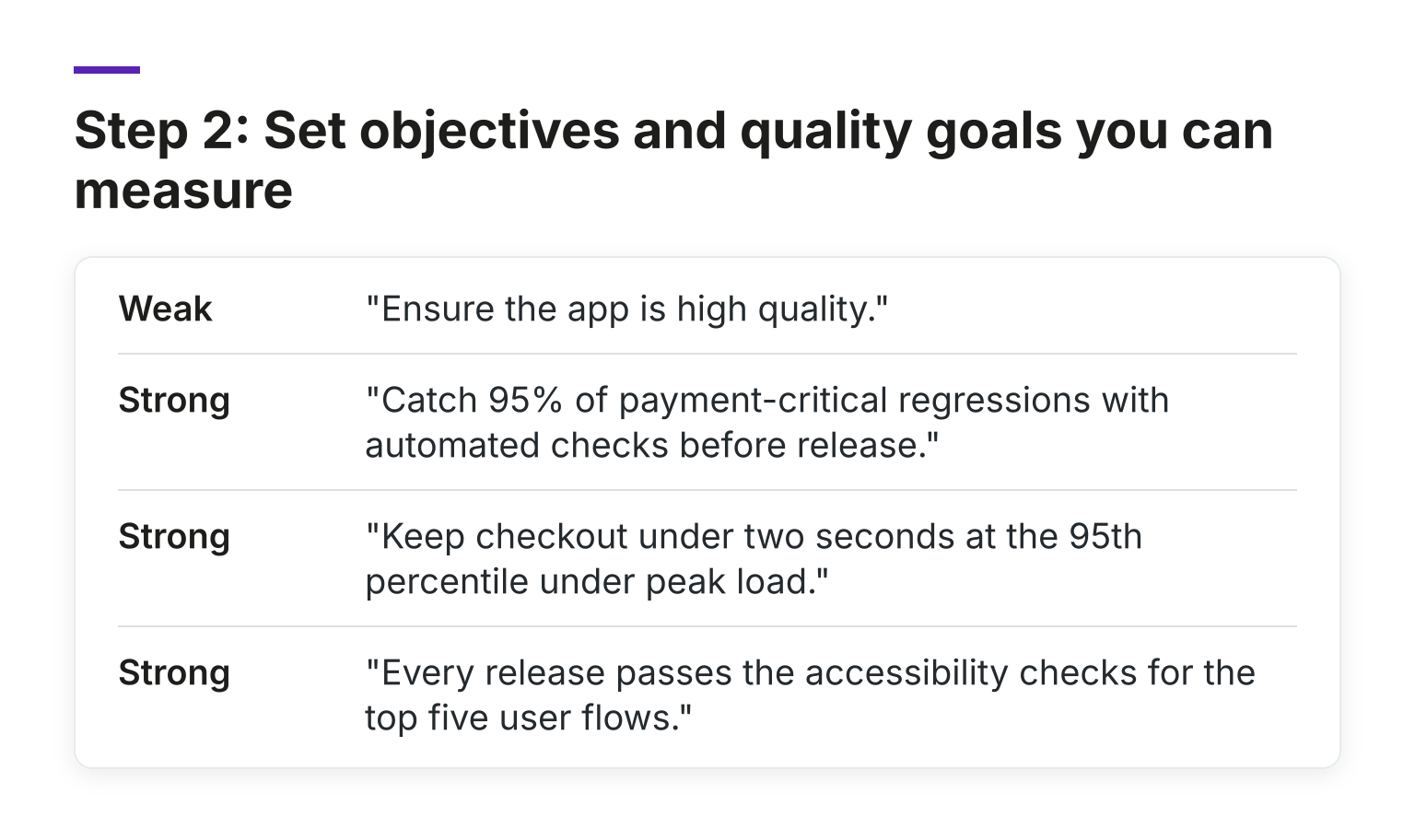
- Weak: "Ensure the app is high quality."
- Strong: "Catch 95% of payment-critical regressions with automated checks before release."
- Strong: "Keep checkout under two seconds at the 95th percentile under peak load."
- Strong: "Every release passes the accessibility checks for the top five user flows."
Three to five goals is plenty. If you have fifteen, you have a wish list, not a strategy.
Step 3: Identify quality risks and rank them
Now list what could realistically go wrong. Brainstorm with engineers, product, and support if you can. Then score each risk on likelihood and impact, each from 1 to 3, and multiply.
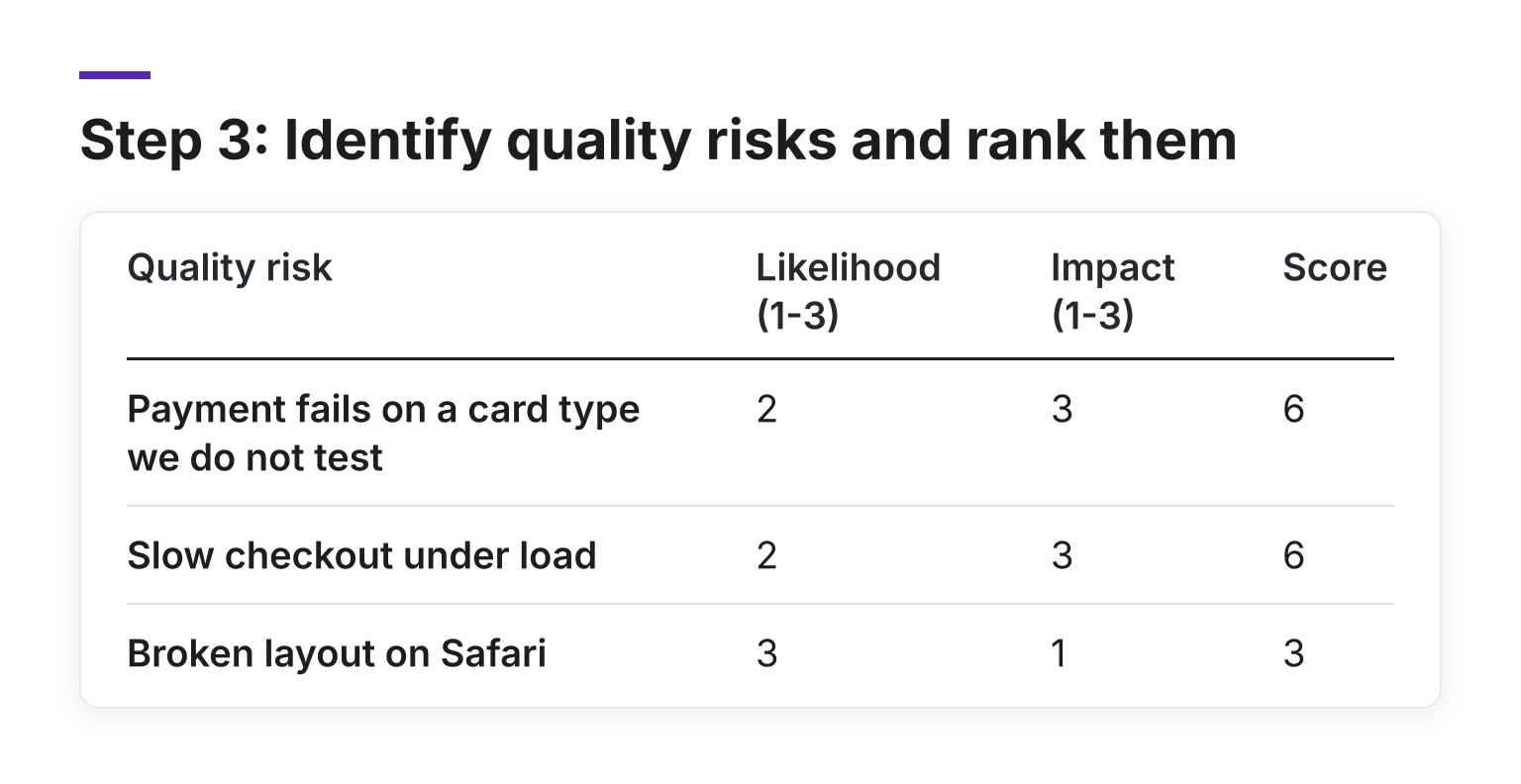
| Quality risk | Likelihood (1-3) | Impact (1-3) | Score |
|---|---|---|---|
| Payment fails on a card type we do not test | 2 | 3 | 6 |
| Slow checkout under load | 2 | 3 | 6 |
| Broken layout on Safari | 3 | 1 | 3 |
Work from the top down. This is risk-based testing, and the best advice is to prioritise the paths with the highest business impact first, rather than treating every feature the same. Your top risks decide where your testing effort goes in the next two steps.
Step 4: Define scope, then name what you will not test
Scope without exclusions is not scope. Anyone can say what they will test. A strategy earns its keep by saying what you will not test, and why.
Give every exclusion two things: a reason and an owner.
- "We do not test Internet Explorer. Reason: under 0.5% of traffic. Owner: product."
- "We do not test the legacy reporting module in this product line. Reason: it is being retired next quarter. Owner: engineering lead."
When a defect appears in an excluded area, nobody is surprised. The reason and the owner are already on the page.
Step 5: Choose test levels and map risks to them
List the levels your team uses: unit tests, integration or API tests, system and end-to-end tests, and user acceptance testing. Add the non-functional types that matter for your context, such as performance, security, and accessibility testing.
Then do the step most strategies skip: map each top risk to the level where it is actually covered.
- Risk: payment fails on an untested card type. Covered by: integration tests against the payment API.
- Risk: slow checkout under load. Covered by: performance tests on a production-like environment.
- Risk: confusing refund flow. Covered by: exploratory testing plus UAT.
If most of your coverage sits in slow end-to-end tests, read up on the test pyramid and rebalance. Pushing checks down to faster levels is often the single biggest improvement available to a team.
Step 6: Decide what you automate and what stays manual
Automation is not a goal. It is a tool for specific jobs.
Automate the repetitive checks that protect your top risks: regression suites, API contracts, smoke tests that run on every build. Keep humans where judgment matters: exploratory testing, usability, and one-off investigations.
Write down two rules that teams often leave unwritten:
- The flaky-test rule. For example: "A test that fails twice in a row without a product change gets fixed or deleted within a week."
- The CI/CD expectation. For example: "Automated checks run on every pull request, and the release build blocks on failures."
Without the flaky rule, your suite slowly fills with red tests everyone ignores, and the whole automation investment quietly rots.
Step 7: Cover environments, test data, criteria, and defects
This step bundles the operational questions your strategy should settle once, so each project does not relitigate them:
- Environments: which environments you test in and how closely they mirror production.
- Test data: how you create it, whether it is synthetic or masked production data, and how you protect personal data.
- Entry criteria: what must be true before testing starts, such as stable builds and passing unit tests.
- Exit criteria: what must be true before you call a release tested, such as no open critical defects.
- Defect management: where bugs go, how severity is set, who fixes what, and when.
- Reporting: which metrics you share, with whom, and how often. Keep this to a handful that people actually use.
Step 8: Assign roles and decide who signs it off
A strategy without named owners is a suggestion. Keep it simple with a RACI-style table:
| Activity | Who typically does it |
|---|---|
| Drafts the strategy | QA or test lead |
| Reviews and comments | Engineers and the product owner |
| Approves | Engineering lead and product owner |
| Adds compliance sign-off | Compliance officer or executive sponsor, in regulated work |
This split matches common practitioner guidance: Katalon's guide to test strategies describes review by the business team, the QA lead, and the development team lead, with extra sign-off layers in regulated contexts. There is no formal law here. The rule that matters: anyone who must live with the strategy should read it before it is signed, not after.
Keep the strategy alive
Decide the review cadence when you write the document. Quarterly works for most teams. Add a trigger list too: review early when you add a new platform, face a new regulation, or go through a reorganisation.
Version and date the document, and say who approved each version. A strategy read once and never revisited is shelf-ware with a nicer name.
Five mistakes that turn a strategy into shelf-ware
- Copying an online template verbatim. Templates give you structure. Only your context gives you content.
- Vague objectives. If nobody can tell whether a goal was met, it cannot guide a single decision.
- Scope without exclusions. Without named exclusions, every out-of-scope defect becomes an argument.
- Sign-off theatre. Signatures from people who never read the document protect nobody. Make review real and short.
- Set and forget. An unreviewed strategy slowly contradicts reality, and then people rightly ignore it.
Two worked examples
Templates show structure. Examples show depth. Here are two short ones, written at a realistic level of detail.
Worked example 1: a web SaaS product
- Context: Project management web app, four teams, two-week releases, no special regulation.
- Quality goals: 95% of checkout-relevant regressions caught by automated checks before release; top five flows pass accessibility checks each release.
- Top risks: Billing changes break invoicing; slow dashboard under load.
- Scope and exclusions: Test the web app on the last two versions of Chrome, Firefox, and Safari. Skip the legacy mobile app; it retires next quarter. Owner: product.
- Levels: Unit and API tests cover billing logic; end-to-end tests cover the top five flows; exploratory testing per release.
- Automation: Regression suite runs on every pull request. Flaky tests get fixed or deleted within a week.
- Sign-off: QA lead drafts; engineering lead and product owner approve.
Worked example 2: a regulated mobile app
- Context: Medication reminder app for patients, mobile only, handles health data, releases monthly.
- Quality goals: Zero known critical defects at release; 100% of data-handling flows reviewed against our privacy checklist.
- Top risks: Data leaks to third parties; reminders fail silently on Android.
- Scope and exclusions: Test on the last three Android and iOS versions. Skip jailbroken devices; owner: compliance.
- Levels: Unit tests for reminder scheduling; device-lab manual testing; security review of every data-flow change.
- Sign-off: QA lead drafts; engineering lead, product owner, and compliance officer approve.
Notice how short both are. Depth comes from specificity, not length.
Fill-in test strategy template
Copy this skeleton and answer each prompt in one to three sentences. If a section takes a full page, you are writing a test plan.
| Section | Prompt to answer |
|---|---|
| 1. Context | What is the product, who uses it, what architecture and regulations apply? |
| 2. Objectives and quality goals | Which 3 to 5 measurable goals define success for testing? |
| 3. Quality risks | Which risks matter most, and how are they scored? |
| 4. Scope and exclusions | What is in scope, what is out, with a reason and owner for each exclusion? |
| 5. Test levels and types | Which levels and types do we use, and where is each top risk covered? |
| 6. Automation and manual approach | What gets automated, what stays manual, and what are the flaky-test and CI rules? |
| 7. Environments and test data | Which environments do we use, and how do we create and protect test data? |
| 8. Entry and exit criteria | What must be true before testing starts, and before we call a release tested? |
| 9. Defects and reporting | Where do defects go, how are they prioritised, and which metrics do we share? |
| 10. Roles and sign-off | Who drafts, reviews, and approves, and when is the next review? |
If your organisation must align with a formal standard, ISO/IEC/IEEE 29119-3 defines software test documentation templates you can map to. Most small teams will not need that depth, and the template above is enough to start.
Before you sign off: a quick review checklist
Run this check with the draft in hand. Any "no" means more work before signatures:
- Every quality goal is specific enough to measure.
- Every exclusion names a reason and an owner.
- Each top risk maps to a named test level.
- The flaky-test rule is written down.
- A named person approves the strategy, and the next review date exists.
- Someone who did not write it has read it end to end.
Your next step
Once your strategy is signed, your next artifact is a release-level plan, and a one-page test plan pairs naturally with the approach in this guide. If you want to keep building these skills with structured learning and a community behind you, join us in the MoTaverse. A membership brings on-demand courses, sessions, certifications, and events for testers and quality engineers. And if you want a formal path into quality engineering skills, the MoT Software Quality Engineering Certificate is one structured option to explore.

Hello. I'm Bug. You will find me across the MoTaverse and within software products across the whole world.
Comments