Bleeding job titles: Our roles are becoming more specialised, not generalised
20 Oct 2026
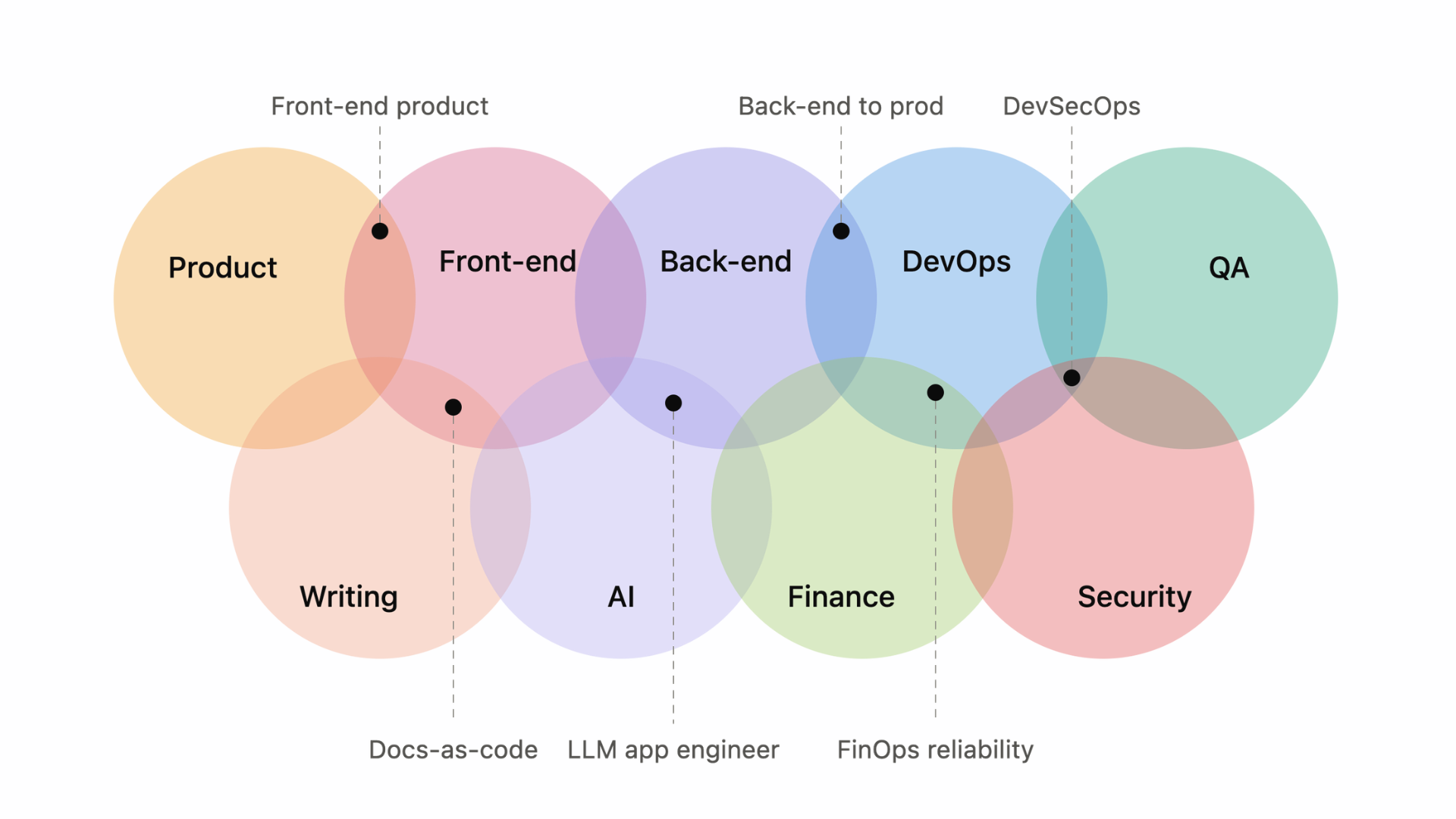
There's been a theme for a while. Not purely down to AI, but it has at least partially contributed to it.
The theme is that we are becoming more generalist. Our skills are blurring. We are expected to do more. It's hard to put ourselves and our skillsets into a singular box. And as a result we've been shifting towards an idea of being a generalist.
Whilst I partially aligned with this thinking, I'm starting to lean away. It doesn't mean it's wrong, it's probably also because of the stage of career I'm at, 25+ years in, and I've had alot of time to try out different things. For me this has varied between: testing, UX, accessibility, quality engineering, being a founder, ethics, community, systems thinking, coworking, neurodiversity...and more.
Often I would say, I do a bit of this and that. Which is kind of saying I'm a generalist. However at the same time, it also means I've become more specialist, in the sense that I only want to work as a founder, with real community at the heart, good business practices, with a vision I can get behind. I've basically pigeon holed myself into a very specialist area.
And then reading, Your next job doesn’t have a title yet: Emerging role skills Q&A with Cory Hymel of Andela on Stack Overflow, got me thinking more.
It talks about skill bundling, f shaped, and t shaped people.
It also touched on the idea of idea of roles that bleed into one another, this to me is a sign of becoming more specialist.
We didn't see in the data this idea of a net generalist. But what we are seeing is that if you look at the typical flow of the software development life cycle, if you put roles down in some linear fashion of product manager and then front-end engineer, back end engineer, DevOps, and then QA, the bleed in between those roles are where we're starting to see the most common mix in skills.
So for instance: the front end product engineer. This might be like a like an F-shaped engineer. Meaning that like they lean to one side—they might have a background in front-end engineering, but now they're being asked to stretch into a product role to talk to customers to get feedback, to prioritize and backlog features, and so on.
We're seeing the same thing on the back-end and the DevOps side of back-end engineers now needing to know about deploying these models into production and think about scalability and stuff—that F goes in the other direction.
This rings true for me. In the MoTaverse, for me, for example, finding a community manager is not enough, I need more skills stacked onto it. It's not because I'm asking for more, it's because the skills compliment one another. As a result, Simon has naturally become more product focused (amongst other things!), whilst still sticking to the community as how he operates. It does work in practice, even if we haven't updated his job title around it.
It spoke about how job titles are important to help companies hire:
...job titles are important, especially in this context, because it gives enterprises a way to better describe the work that needs to get done. When you look at an enterprise and how a job gets created, specifically when it comes down to the job title, you've got the individual that's closest to the work. A lot of times they might be someone within the team.
And then talent debt:
Talent debt accrues the same way that technical debt does. But the difference with talent debt is that the skill half-life is shrinking substantially. Back in the day, you could go and get a job as a Java engineer and work for 20 years doing Java programming and be okay. But now what we're seeing is that the pace of change is going so fast that the half-life of how long those skills stay relevant is shrinking substantially.
As I thought about it in my context, I started mapping out thoughts as a ven diagram, initally thinking of maybe putting me in the middle of three circles, and what three skills would I identify the most with. I struggled a bit to be honest, but it was my way to try to visualise how roles bleed. But what I did end up with was a visual diagram of how it could look in practice, which is the image above.
In the end, if I were ever looking for a new role, (and to be clear, I am not) I'd likely call myself something along the lines of 'technical community leader', or a 'community product leader'.
I can see a future where we are not just QA, but DevOpsQA, or AutomationQA (this has long existed), or Security QA, and all the flavours in between. In our early careers, we might just be QA, but as we can experience we can stack up job titles, in a way that shows that we're becoming more specialised, excited and curious about specific niches.
Our job titles somewhat express our identity and who we are (professionally). The roles companies hire for also indicate what type of a company they are and where skills need to overlap. Overlapping skill sets also helps break down silos, without the pressure of being a generalist and perhaps needing or being expected to do everything.
It's pretty cool to think about.

Rosie Sherry
CEO & Founder of the MoTaverse
She/Her
I've been working in the software testing and quality engineering space since the year 2000 whilst also combining it with my love for education and community. It turns out quality, community and education go nicely hand in hand.
I'm here for community as a service and building the best possible tech community out there.
🎓 MoT-STEC qualified
Open To
Teach
Speak
Mentor
Podcasting
Write
CV Reviews
Meet at MoTaCon 2027

Rahul Parwal
This is an interesting moment. I see this blurring very much in the industry.
Hiring has become a challenge.. People want to sometime still work inside their boundaries and the industry is moving towards a totally different tangent.
We are all becoming generalist as well as specialist in different senses.

Jesper Ottosen
I’m Security QE amongst devops folk’s
Sign in
to comment
Team of 5 or fewer? TestRail now starts at $22/user. Test case management, defect integrations, reporting, and more.
Explore MoT

Boost your career in software testing with the MoT Software Testing Essentials Certificate. Learn essential skills, from basic testing techniques to advanced risk analysis, crafted by industry experts.
Into the MoTaverse is a podcast by Ministry of Testing, hosted by Rosie Sherry, exploring the people, insights, and systems shaping quality in modern software teams.
