I vibe coded a website and I spent half of my time doing quality checks
10 Mar 2026
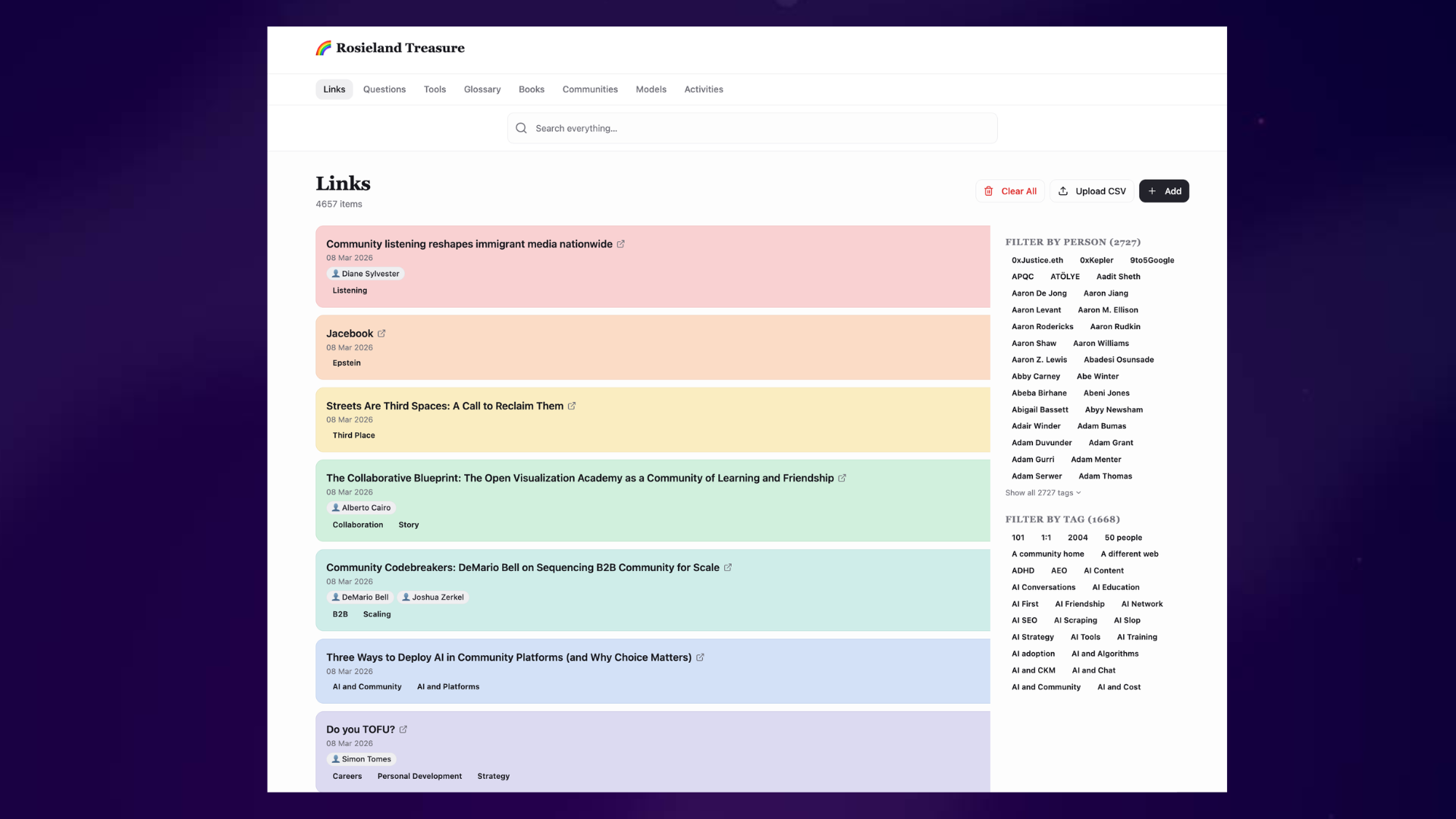
I took advantage of free Lovable credits on Sunday to get a vibe coded prototype of a resource that I've spent the past 6 years building in Notion.
Partly, I was curious on how easily I could replicate a resources with thousands of sources. Another part, Notion, these days is annoying me for what I use it for, I was curious on whether Lovable could be a better solution going forward.
What was I building? A website of a collection of thousands of links, tools, communities, etc that I've built up over the years. I was particularly keen to make it more user-friendly, improve search...and of course a splash of rainbow vibes to it. Honestly, my face lit up when I turned the cards into shades of rainbow pastel colours. I'm such a sucker for these things. The image above is a screenshot of it.
First up, I had so much fun. I love how this can really enable people to build. It was quick and easy to get something up. I felt empowered. I had CSV files to upload, when I had problems with images I made an attempt at scraping, which worked for smaller scale things, not so much for larger requests.
My prompting skills could be improved. As I was experimenting I realised in hindsight how I should've been more specific. At times I thought I was, it was only afterwards where I saw problems occur that I could've done better.
I spent half of my time doing quality checks. It felt fun to ask the AI to fix the problems I saw. I made change and fix requests like I make requests to our dev team, conversational and in the hope that they understand what I mean. It did feel risky and I felt uncomfortable along the way. A lot of it worked. A lot of it took iterations to get right.
My lack of confidence started to rise to the top. I had my quality hat on. I found myself spotting problems, fixing them, considering the risks and implications.
Partly, I was curious on how easily I could replicate a resources with thousands of sources. Another part, Notion, these days is annoying me for what I use it for, I was curious on whether Lovable could be a better solution going forward.
What was I building? A website of a collection of thousands of links, tools, communities, etc that I've built up over the years. I was particularly keen to make it more user-friendly, improve search...and of course a splash of rainbow vibes to it. Honestly, my face lit up when I turned the cards into shades of rainbow pastel colours. I'm such a sucker for these things. The image above is a screenshot of it.
First up, I had so much fun. I love how this can really enable people to build. It was quick and easy to get something up. I felt empowered. I had CSV files to upload, when I had problems with images I made an attempt at scraping, which worked for smaller scale things, not so much for larger requests.
My prompting skills could be improved. As I was experimenting I realised in hindsight how I should've been more specific. At times I thought I was, it was only afterwards where I saw problems occur that I could've done better.
I spent half of my time doing quality checks. It felt fun to ask the AI to fix the problems I saw. I made change and fix requests like I make requests to our dev team, conversational and in the hope that they understand what I mean. It did feel risky and I felt uncomfortable along the way. A lot of it worked. A lot of it took iterations to get right.
My lack of confidence started to rise to the top. I had my quality hat on. I found myself spotting problems, fixing them, considering the risks and implications.
- I started worrying that if I shifted to this way of building that I would lose my data. It felt all too easy to delete stuff and not have a way to have proper data backup. What's the best way to back it up? With Notion this lack of confidence with the data never surfaced.
- Prompting created changes in areas that I never asked for. The navigation randomly changed. Broken links that I had previously fixed reappeared. I found myself feeling the need to constantly check over the whole website. How could I be sure all the data was there? Was it working correctly? How do I approach continually checking
- Security risks creeped in. I made requests to upload things, and it then implemented risky features for anyone to upload and to have delete buttons. Of course, better prompting is probably required, but still, it's learning. All programmers probably start as shit programmers. It can still impact code quality if it's not considered or reviewed.
- I didn't understand behind the scenes. Sure, it's magical that it all just appears. Amazing stuff! But I felt the need to understand how and why decisions were being made. Not knowing gave me a lack of confidence in how stable it would be going forward.
- What did good testing look like in this situation? That feels like it's going to be a whole bunch of other work.
- And then there is the tool. Lovable. It's a unicorn, but who knows whether it will be around in the future, and do I want to suffer the potential conseqences of that.
The shift to AI is about confidence building. I'm sure there are solutions to my concerns. I haven't spent that much time digging into it. I would like to. This is a small scale thing. I can only imagine the stress levels that would arise with bigger and more complex systems. It's easy to rush ahead, but not at the cost of lack of confidence. In a sense, quality is team confidence. We have to find ways to find pace, and ship in a way that makes us feel more confident.
What stuck with me was what I was noticing. I was spending alot of time doing 'quality things'. I guess this won't always be the case, but it's almost like quality hasn't caught up with the coding side. And that's important. Building isn't just about coding. There are other roles that are equally important that need to be considered for.
Will it look different? Sure, most likely, but it's almost like all other roles have been shifted-right in favour of an over glorification of shipping code fast.
Watch out people!

Rosie Sherry
CEO & Founder of the MoTaverse
She/Her
I've been working in the software testing and quality engineering space since the year 2000 whilst also combining it with my love for education and community. It turns out quality, community and education go nicely hand in hand.
I'm here for community as a service and building the best possible tech community out there.
🎓 MoT-STEC qualified
Open To
Teach
Speak
Mentor
Podcasting
Write
CV Reviews
Meet at MoTaCon 2027

Gary Hawkes
This is really cool to read. It certainly parallels with my experience working with devs using coding agents. If their focus is "to build something", thats what their prompts will reflect and focus on. They won't reflect Product context, quality context, support context, security context or user context. Thats primarily why our roles a changing and needed, more than ever.

Rahul Parwal
When I see a community builder like Rosie do such experiments, and publish their moments; I feel great.
AI is a great enabler for all of us. Ofcourse, with time, we will learn to prompt well, engineer context well, and maybe harness well. But this is how it will all start.
Small micro experiments are highly valuable. I still feel that a lot of people are not doing it. We need more experimentors like Rosie.
Sign in
to comment

Manage your entire QA lifecycle in one place. Sync Jira, automate scripts, and use AI to accelerate your testing.
Explore MoT
Complex workflows, flaky tests, fragmented tools, and AI-driven pressure are making it harder for QA teams to keep up.
Boost your career in software testing with the MoT Software Testing Essentials Certificate. Learn essential skills, from basic testing techniques to advanced risk analysis, crafted by industry experts.
Into the MoTaverse is a podcast by Ministry of Testing, hosted by Rosie Sherry, exploring the people, insights, and systems shaping quality in modern software teams.
