Exploring test leadership in a consultancy environment
Lead effectively by learning how to stay composed, organised, and focused while navigating the realities of consultancy work

I am a senior tester who enables Agile testing processes and quality engineering practices. In this article, I share my experiences, challenges, and lessons learnt during my role as interim test lead working with external clients in a consultancy environment.
I have studied and heard a lot of theories about what it is like for a tester in a consultancy project team that practices waterfall methodology. I want to give you some survival tips for that environment, especially if you are new to consultancy like I once was.
How I got the consultancy opportunity
One Wednesday afternoon, my manager told me about an opportunity to work with an external client as interim test lead for a Workday finance implementation. Throughout my relationship with my manager, I have learned to trust her instincts on project choice more than my own, since all the roles she has suggested have been motivational and challenging experiences for me.
To prepare me for my new role, my manager shared waterfall test strategy documents and test plans from a similar Workday implementation project. This is what I learned from reading that material:
- Strategy documents: I understood that traditional ERP implementation teams use heavy, in-depth documentation, complete with timeline diagrams to depict each phase of the waterfall approach with milestones.
- Complex configurations: When you implement complex ERP configurations, many upstream and downstream systems must integrate with the core application itself. This made me realise why waterfall methodology is the go-to choice by the majority of teams who work on these implementations. The requirements are defined clearly and a sequential approach is adapted.
- Delegation: Since various organisations work together in a consultancy environment, the strategy documents have to be very clear on who is responsible for what. Example: for each entry criterion to be met, colleagues from several different service companies will contribute. So delegation and ownership play a pivotal role.
Though there is nothing new in what I just described about the waterfall approach, the lessons we learn real-time in such an environment are always unique!
Grasping the assignment’s programme structure
As a first exercise, I made sure I knew my leadership team members and their roles: engagement manager, engagement director, and engagement partner.
Now, let me take you through some new terms I learnt.
- Engagement: If you are new to the term ‘engagement,’ it is nothing but a contractual agreement between a consultancy firm and the external client. One or more third-party companies will interact with the consultancy and the client team.
- Functional leads: In my engagement, my firm provided the consultant team to the client. The Workday specialists from my firm were the functional leads, and I call them my Marvel superheroes, since they came to my rescue when I needed help on Workday-specific terminology.
- Remit: We have to be very clear on the engagement structure: the various teams, their responsibilities, and team contacts for both consultant and client. We also have to be very confident on what is under our remit. The term ‘remit’ is nothing but the deliverables that are agreed upon according to the contract.
- Contract note: On day one, I joined a meeting during which the engagement managers from both sides discussed my deliverables. Then they drafted a formal agreement on those deliverables, called a ‘contract note.’ The contract note listed all my deliverables in detail. My engagement manager reminded me on several occasions to pursue my deliverables based on the contract note.
Challenges, learnings, and new experiences
I joined the project very late in the timeline, and the testing phase had already begun. All my deliverables circled around the facilitation and orchestration of the end-to-end tests. So I had multiple priorities to tend to, all at once.
Here are the major themes of what I learned.
Make a record of everything you deliver
While we are focused on pushing deliverables to keep the wheels in motion, collecting evidence of what we are contracted for is crucial. My engagement manager pointed this out to me when I forgot to send an email that recorded the defect triage calls that I facilitated. I joked to him that I needed to put my contract in a picture frame on my desk so I could see it all day! From then on, I made sure I sent emails that recorded important meetings like go / no-go decisions, kick-off sessions for testing, and so on.
Keep overall project goals in mind at all times
Make sure you don't focus solely on your daily to-dos. Our thinking pattern should evolve and mature. As test analysts and test leaders, we need to understand the project milestones, roles, and responsibilities of every team. And we also need to understand the engagement leadership, escalation matrix, and more.
Delegate and be strategic
All test managers, not just those in consulting, must learn to delegate. I used to do all the status updates and logging myself. So I was always overwhelmed. Then I realised that I had to start delegating and make the whole team work towards the strategy.
Track real-time result metrics
We wanted to create real-time reporting dashboards for defects and test execution. But Excel, our original tool of choice, is limited in that respect.
Fortunately, the client organisation provided Azure DevOps (AZDO) licences. So we decided to build the dashboards in AZDO. I migrated all the test scenarios from Excel to AZDO. Then I educated the team to use AZDO for any new test cases and defects.
Let me explain in detail how I converted multiple Excel sheets containing test scenarios and execution results into real-time AZDO dashboard results.
- I created an Excel sheet that contained test case titles, descriptions, and expected outcomes for all the test scenarios.
- I uploaded the sheet data to AZDO.
- I created AZDO widgets to track test execution results.
- I created queries to filter bugs related to every business process using tags, and added query results as charts to dashboards.
- After I migrated the existing test cases, I onboarded and trained business analysts and relevant team members to use AZDO to create test plans, record execution results, and track defects. Now the team is confident about having a single online source for test metrics.
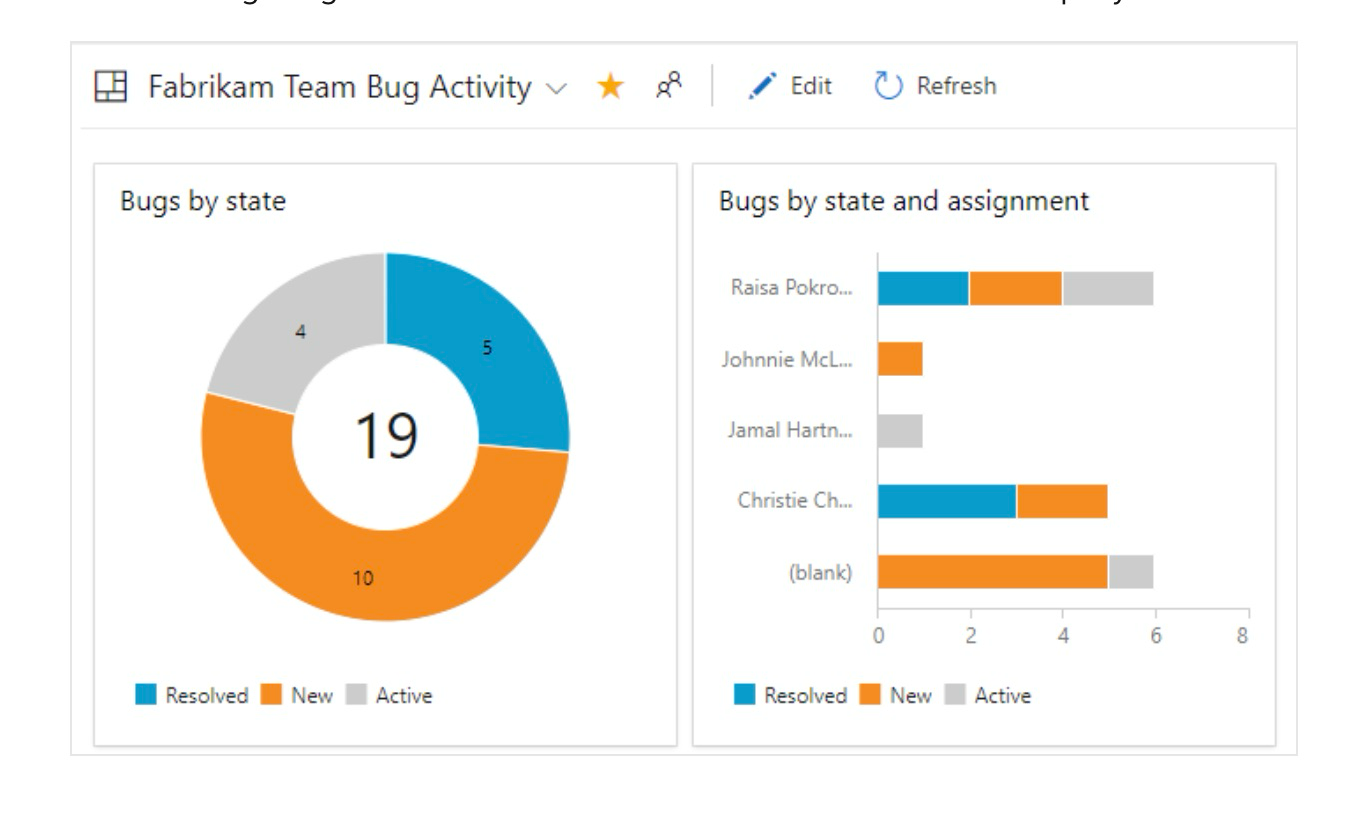
AZDO provides off-the-shelf widgets to visualise testing metrics through charts. I created a dashboard like the one below using query based charts and added the queries to the dashboard. For demonstration purposes I have added an image from Microsoft's official website.
I used pie charts (left side) for state and stacked charts (right side) for priority metrics:
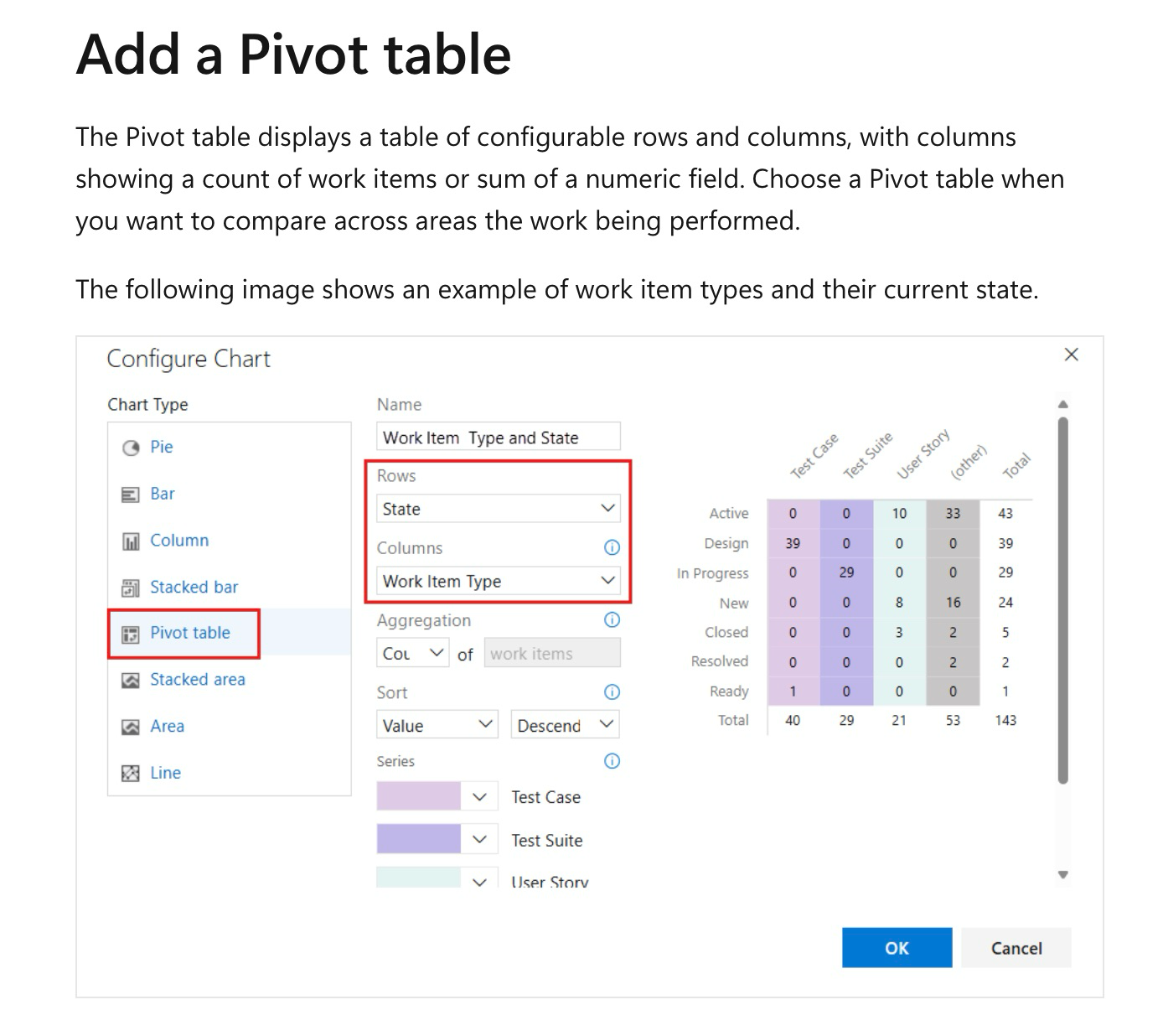
I used pivot tables like the one below for assignee metrics:
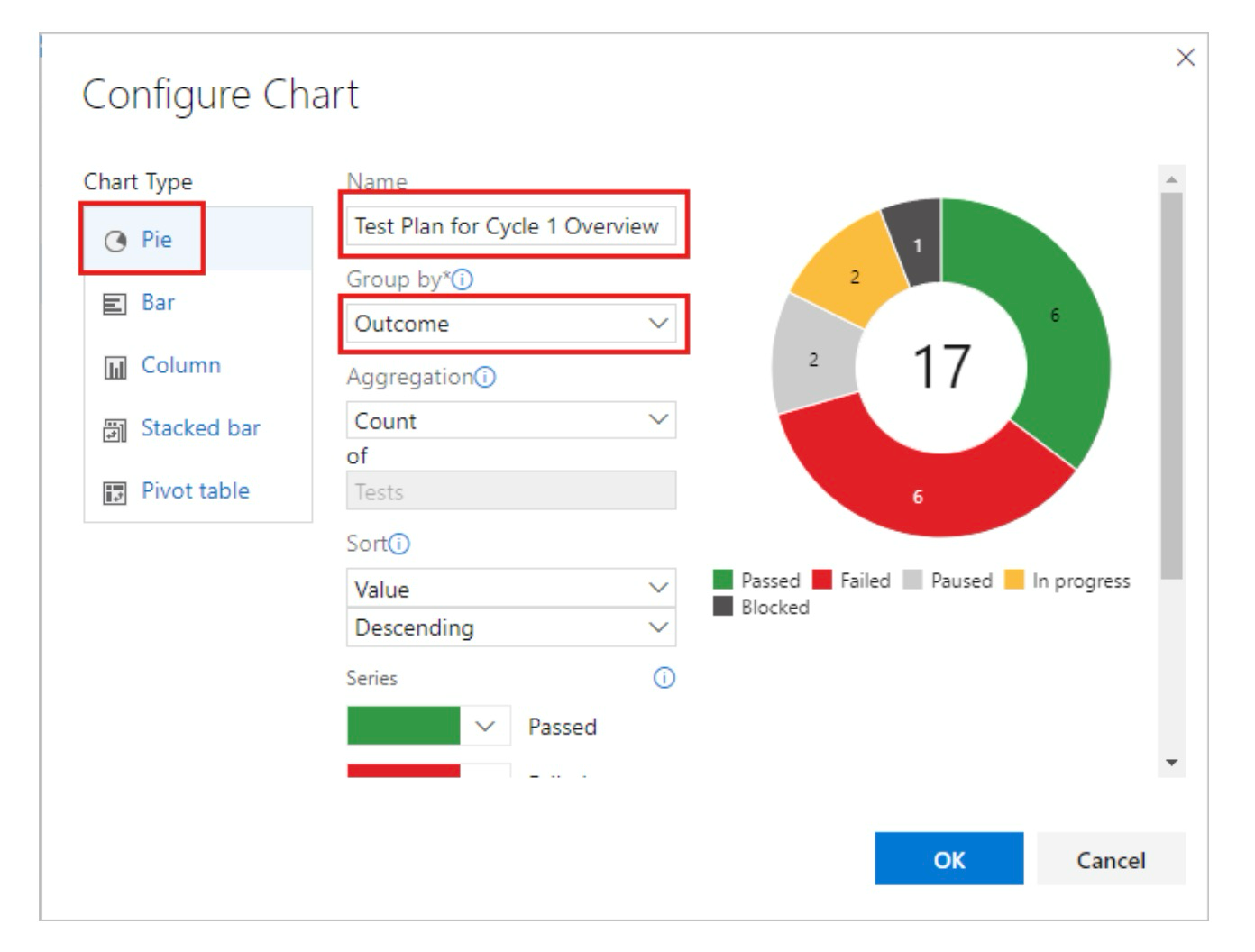
I added charts to test plan folders to see current test execution results.
If I hadn’t had a choice of test reporting tools, I would have had to rely solely on Excel techniques to visualise test outcomes and progress rate. This is when I realised that learning how to generate pivot tables and pie charts for test execution might prove useful someday. Excel does in fact have some real-time reporting capability; for example, pivot tables can be refreshed when the data from the original table changes. In general, reporting from dynamic result generation is more reliable than static hard-coded metrics.
Engage the whole team in quality-related work
At first, both the client and consultant teams appeared to think that it was my responsibility alone to update the entry criteria tracker sheet, RAID log, availability tracker, and so on. This wasn’t sustainable. Before long, I began to encourage them to update the trackers themselves, and they started doing so. As is often said, the whole team owns quality, and that includes status updates.
Build and maintain supportive relationships
When we are in a consulting environment, we work with colleagues from inside and outside our firm. We sometimes witness a clash of working cultures and differences of opinion as to good process. In many instances, we will feel the friction, but we need to find ways to balance the different mindsets and cultivate a positive work environment.
My line manager and colleagues from my testing team were part of my circle of trust whom I asked for advice on these conflicts. Remember that you can always create your own support system and that you should work to maintain it.
Embracing the unknown and gaining new perspectives
There wasn’t a single day that went by that I didn’t feel like an alien when it came to new terminology related to Workday. I felt challenged to balance learning new material and focusing on deliverables.
Here’s what I struggled with and what I learnt:
Do you feel like you can never get to the bottom of your to-do list, since it keeps growing? Remember that you cannot force project completion in a single day and there are many pieces that need to come together as the project continues.
- Do you feel anxious when people ask you questions but you don't have answers right away? Embrace the unknown, speak to people, learn, do research if you need to, and get back to them. You do not have to have all the answers for immediate responses, and it’s possible that you will not have answers to some questions at all.
- Do you feel you have grown well in your career until now, but now you feel you are back in grade school? Realise ‘What you have learned is a mere handful and what you are yet to learn is the size of the whole world’
- Do you feel like giving up? I was on the verge of giving up in my first week. I felt far from everything I enjoyed doing in my testing career so far: Agile practices and test automation. When I expressed this to my manager, she never judged me. She reassured me with positive advice and she lent her ears patiently when I needed someone to listen to my rants. Day after day, our chats and meetings were interesting and comforting. I started thanking her for the opportunity, and as the project drew to a close, we spoke about how easy my days had become.
To wrap up
I hope you find this article handy when you need survival tips for your first consultancy role. I feel that getting into consultancy roles will make testers explore and strengthen their product-specific testing and test management expertise.
Testing fundamentals don’t really change no matter where we work, but team dynamics and product-specific learning curves makes things challenging initially. Once we gain this knowledge and understand what is in scope for the project, planning and delegation are a cake walk.
What do YOU think?
Got comments or thoughts? Share them in the comments box below. If you like, use the ideas below as starting points for reflection and discussion.
Questions to discuss
- When you were in a consulting environment, what was the greatest challenge in putting the test strategy together?
- Have you ever been a test lead for an ERP implementation when you are new to the tool?
- Have you ever orchestrated test plan and execution across teams in different geographic areas and time zones?
For more information
- Experience Report: Introducing Change To An Organisation As A Test Consultant, Beren Van Daele
- Forget about job titles! Testing leadership for all, Jesper Ottosen
- Qualitative Risk-Based Test Reporting, Nancy Kelln

I am a very curious Senior Quality Engineer who is more driven towards automation and promotes shifting left. I have proven experience as an agile tester having strong fundamentals in manual and automation testing principles. I enjoy the entire journey from setting the automation framework from scratch to building the pipelines onto continuous integration tools like Jenkins.
My framework adds more flavor by incorporating service layer (APIs) calls with UI layer automation which we call it 'Seaming' in automation terms. I communicate with stakeholders about risks, accessibility and pain points rather than number of passes/fails.
I test with a purpose by automating business flow and add in appropriate plug-ins to make the automation reports/metrics readable for stakeholders. I also love to take part in agile ceremonies and volunteer to run retrospectives/daily scrums to keep the team self thriving in temporary absence of the scrum master.
When I'm not scripting, I love to binge on Netflix, indulge in testing communities, read about Web3 and all things Quality :-) I am a yogic person too. If anything that calms me that's a cup of chai and a morning walk in the park.
Comments