
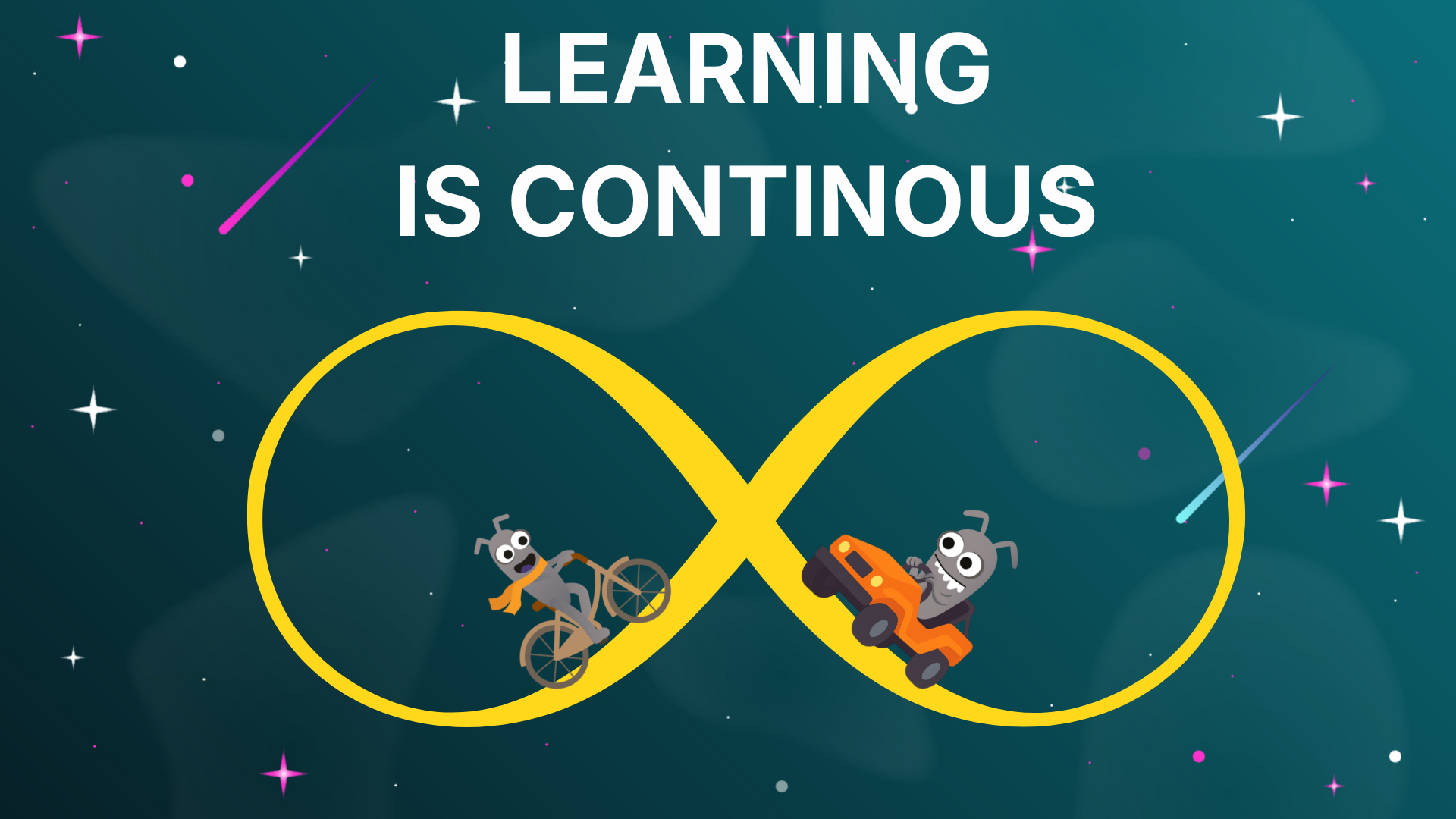
In tech, we work in small iterations, why not approach learning the same?
28 Apr 2026
In this moment:
Nataliia Burmei
I predict a huge fundamental shift will happen when it comes to learning and professional development.
Infact, it's already happening. If you've been in the tech space for a while, you may have noticed. Learning and development has changed. Long gone are the long 3-5 day (in person!) courses and the hefty prices often associated with it.
What has come into place is small and iterative learning. The problem is, we don't always recognise it as that. Sometimes it happens at work. Other times it's reading a blog post. It can also happen as part of a short online course.
Learning can happen in conversation. Peer to peer, at work, or within the community. This could be listening into a podcast, or perhaps even joining one. Recently, in the MoTaverse, we've been pairing people up for conversations too. The goal is not viral content, the intent is that is a learning experience for everyone in the room. It is an experience of value, which just happens to be recorded and published.
Learning also happens attending events. Meetups/Chapters. Virtual Masterclass style sessions. And Chapters. It's hard not to learn when you show up at these things.
We can then process our learning, through a forum, as blog posts, or as we have in the MoTaverse, in Moments. However, learning isn't just about what knowledge you retain, it's also about learning to process and find confidence. In this sense, the act of preparing and doing a talk is learning too.
The point is not for me to list out a comprehensive way of how people actually learn. The point is to show that this is all learning. And we must learn to accept that and build it into our tech careers.
The MoTaverse is built for this social learning. It recognises your contributions. It tracks them. It allows you to show up in the way that best suits you. It doesn't rank a type of learning higher than another. It's being designed to create a natural history of your work, learning and efforts, on your terms.
Some people show up for virtual events. Others like to write. Some simply come for our annual conference. Others like to brave the stage.
Even our formal learning (certifications) is somewhat social in the fact that you meet people from the community along the way and you are encouraged to share your learnings along the way.
I say we are here 24/7/465 (or 24/7/404 is my new favourite term), and perhaps this is the best signal that the MoTaverse is here for small, iterative and continuous learning to support your career.
Come for the courses, stay for the iterative learning.
Come for the certification, stay for the iterative learning.
Come for the community, stay for the iterative learning.
And perhaps most importantly, have fun and make friends along the way.
And thanks to Nataliia Burmei who inspired this angle in our monthly Ambassdors call.
Infact, it's already happening. If you've been in the tech space for a while, you may have noticed. Learning and development has changed. Long gone are the long 3-5 day (in person!) courses and the hefty prices often associated with it.
What has come into place is small and iterative learning. The problem is, we don't always recognise it as that. Sometimes it happens at work. Other times it's reading a blog post. It can also happen as part of a short online course.
Learning can happen in conversation. Peer to peer, at work, or within the community. This could be listening into a podcast, or perhaps even joining one. Recently, in the MoTaverse, we've been pairing people up for conversations too. The goal is not viral content, the intent is that is a learning experience for everyone in the room. It is an experience of value, which just happens to be recorded and published.
Learning also happens attending events. Meetups/Chapters. Virtual Masterclass style sessions. And Chapters. It's hard not to learn when you show up at these things.
We can then process our learning, through a forum, as blog posts, or as we have in the MoTaverse, in Moments. However, learning isn't just about what knowledge you retain, it's also about learning to process and find confidence. In this sense, the act of preparing and doing a talk is learning too.
The point is not for me to list out a comprehensive way of how people actually learn. The point is to show that this is all learning. And we must learn to accept that and build it into our tech careers.
The MoTaverse is built for this social learning. It recognises your contributions. It tracks them. It allows you to show up in the way that best suits you. It doesn't rank a type of learning higher than another. It's being designed to create a natural history of your work, learning and efforts, on your terms.
Some people show up for virtual events. Others like to write. Some simply come for our annual conference. Others like to brave the stage.
Even our formal learning (certifications) is somewhat social in the fact that you meet people from the community along the way and you are encouraged to share your learnings along the way.
I say we are here 24/7/465 (or 24/7/404 is my new favourite term), and perhaps this is the best signal that the MoTaverse is here for small, iterative and continuous learning to support your career.
Come for the courses, stay for the iterative learning.
Come for the certification, stay for the iterative learning.
Come for the community, stay for the iterative learning.
And perhaps most importantly, have fun and make friends along the way.
And thanks to Nataliia Burmei who inspired this angle in our monthly Ambassdors call.

Rosie Sherry
CEO & Founder at Ministry of Testing
She/Her
I've been working in the software testing and quality engineering space since the year 2000 whilst also combining it with my love for education and community. It turns out quality, community and education go nicely hand in hand.
🎓 MoT-STEC qualified
Open To
Speak
Meet at MoTaCon 2026
Write
Mentor
CV Reviews
Podcasting
Teach

Nataliia Burmei
I think we live in such fast paced time that it can become counterproductive to follow only structural learning. Some things can become irrelevant by the time you finish them.
It reminds me of sticking too much to waterfall model when the world is agile. It just doesn't add up. (comment 1/2)
Nataliia Burmei
I also think we humans don't always appreciate small learnings, we take it for granted. We are more impressed with big ones. If one does small learning every day (one article, one comment, one MCP command, one chat with PM that landed well) and make one learning continuously for a month, it will be significant progress at the end. It's similar to gym sessions, running trainings. Your brain muscle isn't different. (comment 2/2)
Sign in
to comment
BearQ continuously tests your app, reducing test maintenance and uncovering gaps scripted tests can miss.
Explore MoT

See how agentic testing workflows help teams deliver faster without sacrificing quality.
Boost your career in software testing with the MoT Software Testing Essentials Certificate. Learn essential skills, from basic testing techniques to advanced risk analysis, crafted by industry experts.
Into the MoTaverse is a podcast by Ministry of Testing, hosted by Rosie Sherry, exploring the people, insights, and systems shaping quality in modern software teams.
