
Staying in Control with AI Agents
02 May 2026
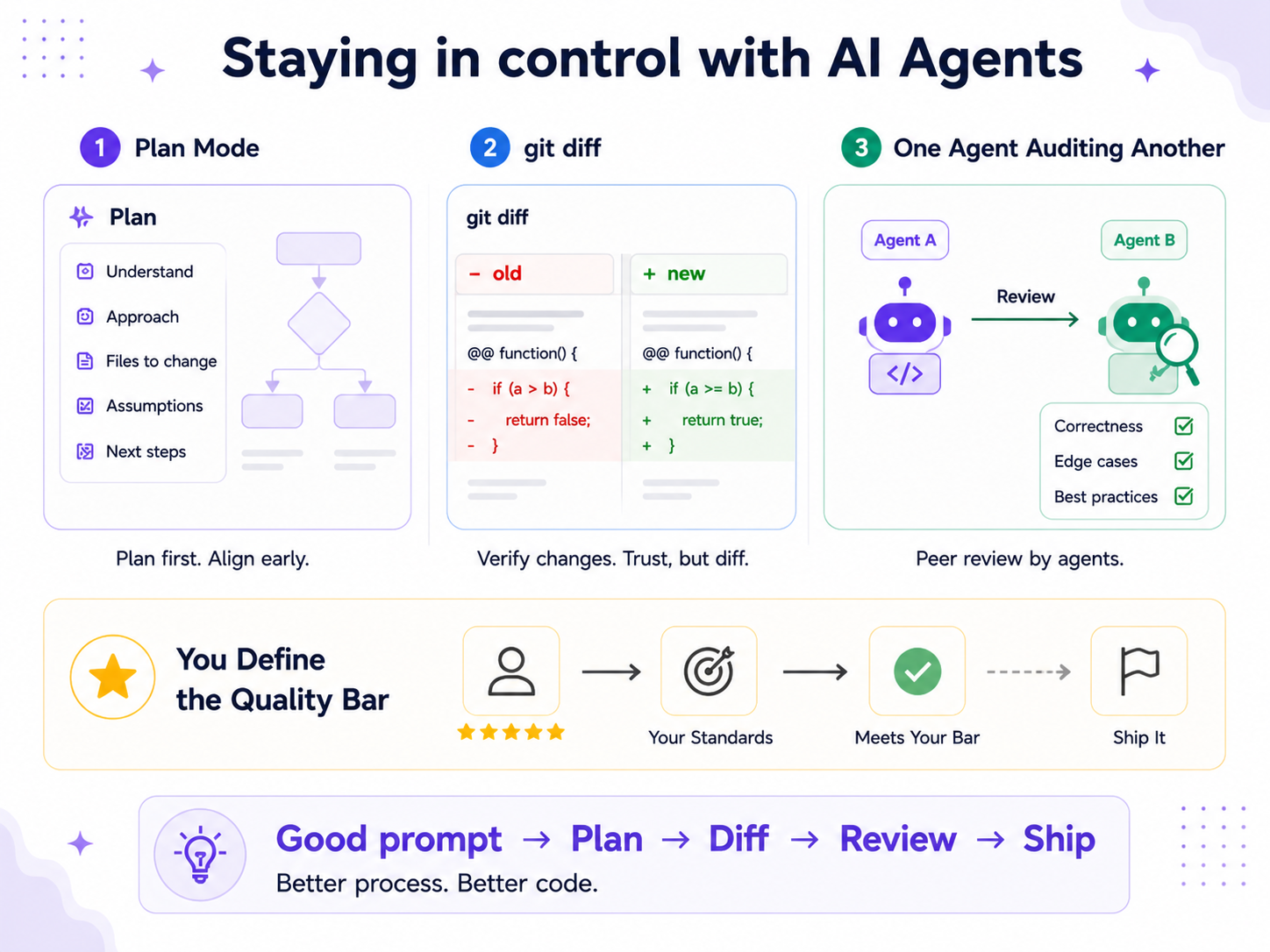
In this moment:
Rahul Parwal
AI Chapter
The AI didn't make a mistake. You did. You trusted it.
The AI doesn't know your quality bar. It doesn't know your edge cases. It doesn't know what "good enough" means in your codebase.
It only knows what you tell it. And most people tell almost nothing.
The engineers staying in control are doing something different:
1. They use plan mode:
- Understand → approach → files to change → assumptions → next steps.
- Misalignment caught early costs 0. Misalignment caught after the output is generated costs a lot.
2. They git diff before they push.
- Git diff is not optional. It's your first line of defense.
- Trust the agent. But diff the output. Always.
3. They audit agents with agents.
- Agent A writes the code. Agent B reviews it.
- Audit angles: correctness, edge cases, best practices.
4. They define the quality bar explicitly.
- The AI will meet your bar. But only if you set it.
- Vague expectations → vague output → vague regret.
This is the process most people skip.
TL;DR below 👇
→ Good prompt → Plan → Diff → Review → Ship
The people who figured this out aren't writing more prompts.
You can learn this and more from this article 👇. Read it before your next agent session.
How to Stay in Control of AI Coding Agents: A Practical Guide for Testers Using Claude Code and GitHub Copilot | ShiftSync Community
The AI doesn't know your quality bar. It doesn't know your edge cases. It doesn't know what "good enough" means in your codebase.
It only knows what you tell it. And most people tell almost nothing.
The engineers staying in control are doing something different:
1. They use plan mode:
- Understand → approach → files to change → assumptions → next steps.
- Misalignment caught early costs 0. Misalignment caught after the output is generated costs a lot.
2. They git diff before they push.
- Git diff is not optional. It's your first line of defense.
- Trust the agent. But diff the output. Always.
3. They audit agents with agents.
- Agent A writes the code. Agent B reviews it.
- Audit angles: correctness, edge cases, best practices.
4. They define the quality bar explicitly.
- The AI will meet your bar. But only if you set it.
- Vague expectations → vague output → vague regret.
This is the process most people skip.
TL;DR below 👇
→ Good prompt → Plan → Diff → Review → Ship
The people who figured this out aren't writing more prompts.
You can learn this and more from this article 👇. Read it before your next agent session.
How to Stay in Control of AI Coding Agents: A Practical Guide for Testers Using Claude Code and GitHub Copilot | ShiftSync Community

Rahul Parwal
Test Specialist
Rahul Parwal is a Test Specialist with expertise in testing, automation, and AI in testing. He’s an award-winning tester, and international speaker.
Want to know more, Check out testingtitbits.com
Open To
Teach
Speak
Mentor
Podcasting
Meet at MoTaCon 2026
Review Conference Proposals
Write
CV Reviews
Sign in
to comment
BearQ continuously tests your app, reducing test maintenance and uncovering gaps scripted tests can miss.
Explore MoT

Thu, 1 Oct
A tech conference to help you navigate the ever-shifting landscape of Quality Engineering, AI, Leadership, Product, Accessibility and Security.
Advanced prompting skills to turn AI into your trusted testing companion.
Debrief the week in Quality via a community radio show hosted by Simon Tomes and members of the community
