
Patrick Prill

Patrick Prill
Expert Quality Engineer
he/grumpy
22 years as tester, and counting. Retired TestBash Munich organizer.
🎂 MoTaBirthday | April 17, 2015
Open To
Work
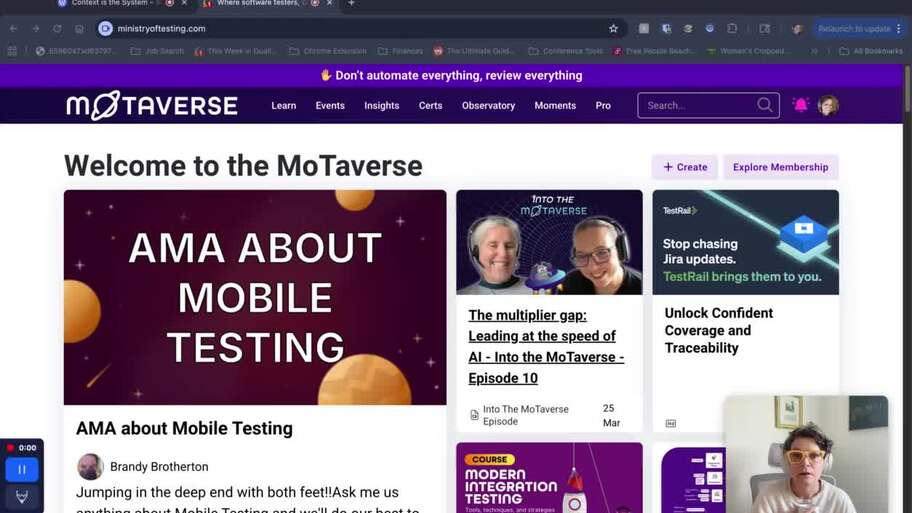
This is a typical Thursday for me - reading great articles and sharing them to the community. However, to stay more organized, I make sure that what I read is in the Observatory and is added to my ...
26 Mar
Watch "Rise of the Guardians: Testing Machine Learning Algorithms 101" Patrick Prill from TestBash Brighton 2019
3 Apr
Watch "Accepting Ignorance – The Force of a Good Tester" TestBash Talk with Patrick Prill
7 Apr
Friction
Friction is not a bug. Friction is the mechanism by which we build understanding. Every shortcut you take through a problem is a piece of understanding you didn’t build. And understanding compounds. The person who struggled through debugging for years sees patterns that the person who always asked AI simply cannot see.
My friend Stu Crocker once said something that stuck with me deeply: “Quality is the absence of unnecessary friction.” I love that and made it my mantra. But the key word is “unnecessary.” Not all friction is bad. Some friction is the price of admission. It’s on us to learn to tell the difference between the friction we should eliminate and the friction we need to push through. No pain, no gain, as they say. And right now, too many people are removing all the friction, including the kind that makes them grow.
Zooming
There is an activity as part of Systems Thinking which is zooming in and zooming out. According to studies at the Cornell University people tend to not zoom out. Nearly everyone zooms in, nearly no one zooms out. I think that I’m part of “nearly no one”. In Systems Thinking theory zooming in refers to breaking up a whole into parts. Then taking a part and breaking it up again, and so on. Zooming out is taking a whole and looking at it as part of something bigger. Then taking that again and look what it’s a part of. When using different perspectives zooming in and zooming out is not necessarily a repeatable process.
Manual Testing
Before my actual testing career started, I was a "manual tester" for a week in ~2001, stepping in for a colleague. My job was to test the installation manual for a piece of software. That is what manual tester means in the context of software, right?
Context is the System – What AI Prompting and Systems Thinking Have in Common
(testpappy.wordpress.com)
21 Mar




Not registered for any upcoming events
Observatory MoTivator
This badge is awarded to those tagged in 10 Observatory links.
Badge Award
about 1 month ago
Observatory Enabler
This badge is awarded to those tagged in their first Observatory link.
Badge Award
about 1 month ago
Moment-um Builder
This badge is awarded to those that have been tagged in their first Moment.
Badge Award
about 1 month ago
Est 2015
This badge is awarded to those that joined the MoTaverse in 2015.
Badge Award
about 1 month ago
Learner finished your session
Accepting Ignorance – The Force of a Good Tester – Patrick Prill
Community Star
about 2 months ago
