Activity (50)
Course (40)
Glossary Term (1030)
Insight (765)
Certification (91)
Collection (313)
Session (2327)
Moment (7135)
Newsletter Issue (359)
News (412)
Link (4230)
Solution (81)



Definition: A database designed to store and query values recorded over time, where each value is tied to a timestamp. It is commonly used to hold metrics such as request counts, error rates and response times.
So what? It is where observability metrics live, which makes it possible to chart how a system behaves over minutes, hours or days and spot when something changes.
Example: Storing the number of failed checkout requests every few seconds so a team can see whether errors rose after a release.

Definition: A browser metric that measured the delay between a user's first interaction with a page and the moment the browser could begin handling it. It was replaced by Interaction to Next Paint (INP) as a Core Web Vital in 2024.
So what? Because it covered only the first input, it could miss slow responses later in a session, which is why INP replaced it.
Example: A page that responds quickly to the first click but becomes sluggish once more scripts load would score well on FID yet still feel slow to use.

Definition: A set of browser metrics defined by Google to describe a page's user experience in terms of loading, responsiveness and stability. The current set is Largest Contentful Paint (LCP), Interaction to Next Paint (INP) and Cumulative Layout Shift (CLS).
So what? They give teams a shared, user-focused set of questions to watch when observing how a site behaves in real browsers.
Example: A team dashboard tracking LCP, INP and CLS for the checkout pages so that a slowdown after a release is spotted quickly.

Definition: A browser metric that measures how long it takes for the page to visually update after a user interacts with it, such as a click, tap or key press. It is the responsiveness signal within Google's Core Web Vitals.
So what? It shows whether a page feels responsive to the person using it, across their interactions rather than just the first one.
Example: A user taps "Add to basket" and the button takes nearly a second to show any change because the browser is busy running scripts.

Definition: A browser metric that measures when the largest visible piece of content on a page, such as a hero image or main heading, appears for the user. It is the loading signal within Google's Core Web Vitals.So what? It answers a simple question from the user's side of the screen: when does the main content actually show up? This makes it a useful signal for observing loading performance in real browsers.Example: A product page where the main product photo takes four seconds to appear because it was uploaded at full resolution.





Everyone's talking about AI agents. Far fewer people know how to test them.

When I read about a 2024 attack that was done through accessing a test account, it reminded me of when I was remoted into a customer site to diagnose and used my usual password for test accounts to...






Every Oracle Cloud update raises the same question: which tests broke this time, and who's fixing them? We're at Oracle AI World to show what happens when an AI agent takes on test creation, mainte...


There are countless ways to show up and contribute. Which one will you try today?

Manage your entire QA lifecycle in one place. Sync Jira, automate scripts, and use AI to accelerate your testing.
Take this 7-question assessment to see where your QA team stands and get a plan for what to automate next.
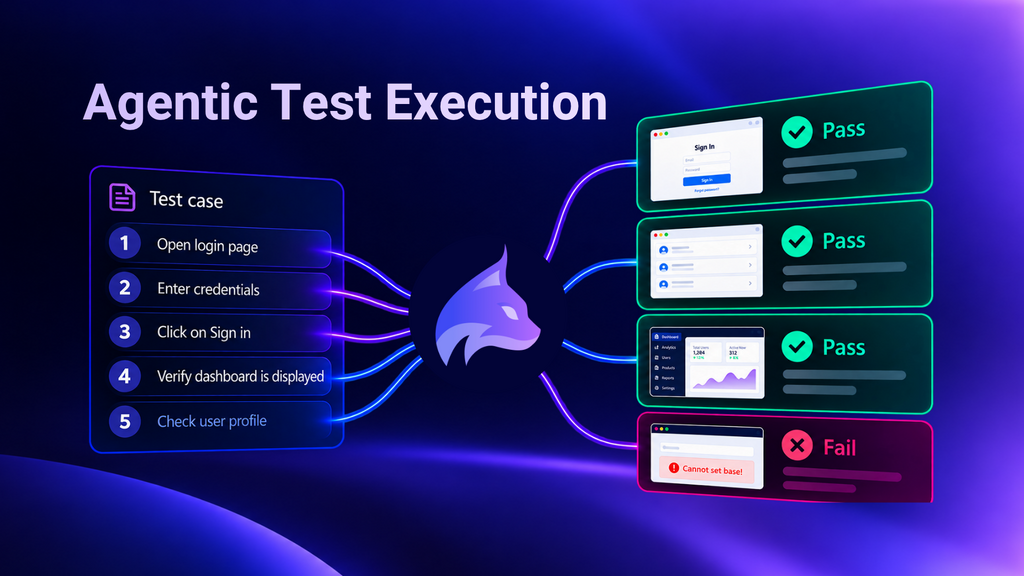
See how Lynqa runs your existing tests as written, captures step-by-step evidence, without code or no-code.
