
Dragan Spiridonov

Dragan Spiridonov
Head of Agentic Quality Engineering @ Cognitum.One | Ambassador, Agentics Foundation
In IT since 1996, establishing and leading QA/QE functions since 2014.
8 years at Alchemy, building QA/QE from scratch.
Since October 2025, the founder of Quantum QE, Ambassador for Agentics Foundation Serbian chapter, and creator of the Agentic QE framework and Agentic QE Fleet, an open-source AI-powered QA/QE platform.
🎂 MoTaBirthday | April 19, 2015
Open To
Write
Teach
Mentor
Speak
Podcasting

Join us today. We have a lot of exciting events coming up for you. 📅 23 Sep: Maneesh Madalla: Guardrails & Evals: keeping your AI skills honest.📅 22 Oct: Naveen Khunteta, Naveen AutomationLab...
22 Sep

Loop engineering is moving from prompting agents and towards designing the systems that prompt.And for what it's worth, no, I am not looping yet, I'm still happy prompting away.However, Addyo Osma...
11 Jun

Following the trend from Rosie and Dragan I tried the prompt too 😄The prompt: Hey ChatGPT, write a totally bonkers, unhinged bio about me (Parveen Khan) in 200 words.Then, create an image.
19 May
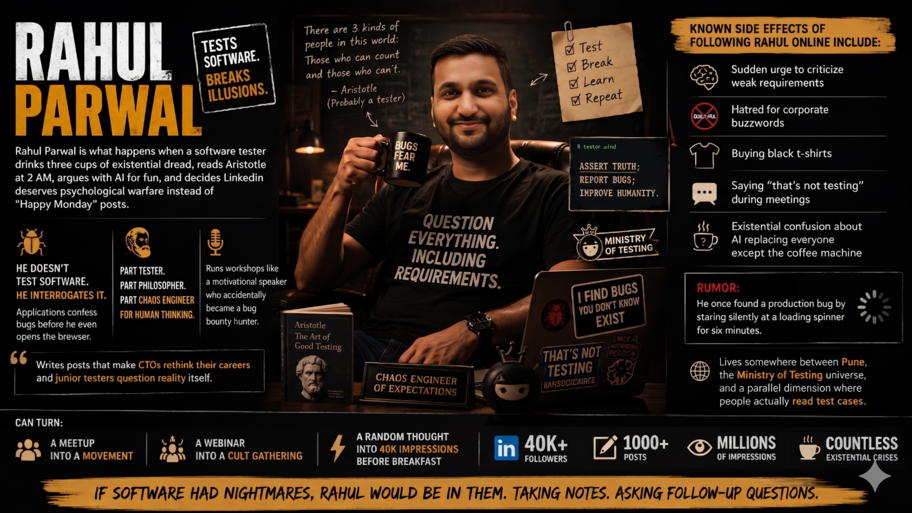
The prompt: Hey ChatGPT, write a totally bonkers, unhinged bio about me (Rahul Parwal) in 200 words. Then, create an image.Inspired by Dragan Spiridonov and rosie sherry 🐌 unhinged bio moment...
17 May
Learn how software engineering is shifting from basic prompt engineering to autonomous AI agents and intent-based workflows.
16 Jul
A paradigm shift from using AI as a coding assistant to directing AI agents as an intelligent workforce
20 Mar
Comments
(1)
Sources of Testing / Tech / AI Information
Six months ago, I set up a daily Perplexity task to generate summaries of topics of interest. Here is an example prompt/result from a couple of days ago https://www.perplexity.ai/search/fetch-the-latest-information-n-qTY2NGAQTCCB6GiRIhNr9Q
I have tried using OpenClaw for a similar task for a couple of weeks, but because it requires API LLM access, it incurred additional costs.
Yesterday, I set up a daily scheduled task in Claude Cowork for a daily digest, included in the subscription.
When the Pipeline Became the Bottleneck - latest article on The Quality Forge blog
(forge-quality.dev)
30 Sep
ailments - a field guide to potential AI-induced cognitive-behavioural disorders
(informationisbeautiful.net)
10 Aug
10 Aug




Not registered for any upcoming events
