
Cassandra H. Leung
Cassandra H. Leung
Senior Quality Engineer
she / they
Quality Coach | Scrum Master | UX Enthusiast | Tech Blogger | International Speaker | Exploratory Tester | Test Strategist | MoT Content Creator
🎂 MoTaBirthday | October 24, 2016
Open To
Speak
Write
Podcasting
As I wait for Claude Code to complete a series of tasks for me, one thing comes to mind. Am I more lazy, impatient, or cautious of gaps?It occurs to me that AI can be a great assistant, but o...
7 Aug
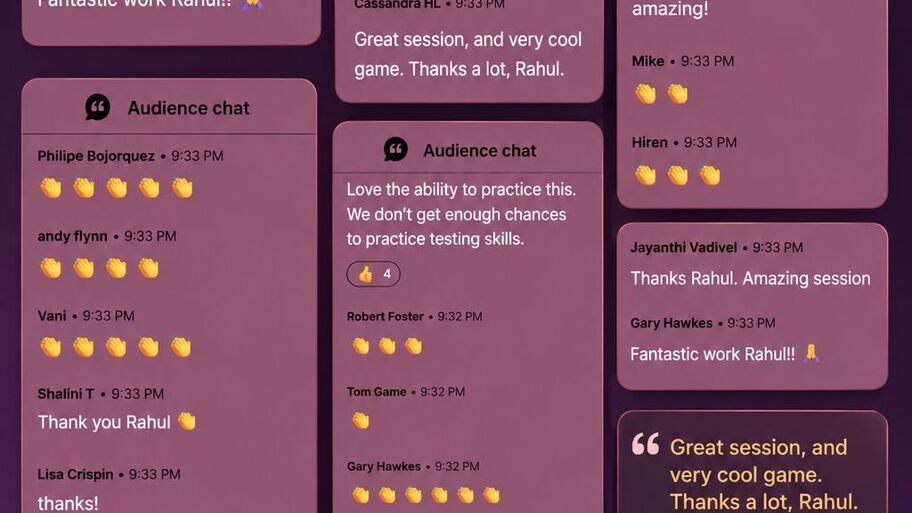
Thank you to everyone who joined my AI masterclass yesterday!Loved the engagement, energy, and enthusiasm that you all brought.Of course, always grateful for the opportunities like these.Than...
7 May
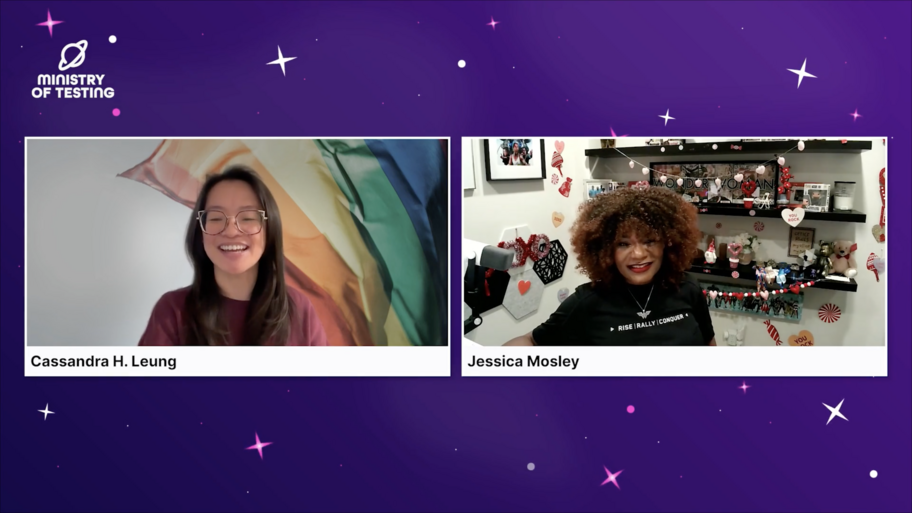
Very much enjoyed a practical discussion between Cassandra H. Leung and Jessica Mosley.As part of the Software Quality Engineering Certificate (SQEC), Module 9 Lesson 3, they discuss how to qu...
26 Mar
This question is taken from the AMA about quality beyond correctness, and comes from Gary Hawkes.
How do you communicate confidence in quality to those outside QE, when the confidence is beyond jus...
23 Mar

I use my saved prompts when working with Gen AI platforms, the results are more predictable and it saves me time.
13 Jun

Gain useful tips on making a successful career change into software testing
18 Jun
Set meaningful goals, communicate quality through risks and real-world consequences, and turn small wins like building a quality narrative into career growth.
30 Jan
Celebrate the creativity and courage of testers and quality engineers as they share stories, lessons, and ideas in just 99 seconds.
20 Oct
Eating Your Own Dog Food (Dogfooding)
"Eating your own dog food" is an expression meaning that the creator(s) of a product / service also use that product / service as a way to test and gather feedback. Whilst this can provide good, real-world insights as to the experience of using the product / service in question, others argue that this should not be the sole means of testing, as creators are inherently biased towards viewing their creations in a positive light, meaning that critical issues and poor user experiences (UX) could go unnoticed and / or unresolved.
Net Promoter Score (NPS)
A net promoter score (or NPS) is a measure of customer loyalty and satisfaction, by way of survey. Real customers / users are asked to share how likely they would be to recommend a particular product, service, or company. Those scores are then used to calculate the NPS, giving an indication of the general sentiment towards the survey subject. Some have argued that, if someone is aware of the scoring system, this affects how they will score the subject. For this reason, no details of the scoring system are provided here.
Oracles
An oracle is a type of heuristic which guides one's reasoning as to what is correct. They can be useful, but are also fallible.For example, one might deem a certain behaviour correct because of a set of acceptance criteria on the ticket which implemented the behaviour. However, upon speaking with the product owner, one might discover that the requirements have since changed, and the behaviour is now incorrect. In this case, both the acceptance criteria on the ticket and the discussion with the product owner are reasonable oracles (things on which to base one's assessment), but one is no longer correct.
Mutation testing
Mutation testing is a method used in the context of automated checks / tests. Rather than testing the code, mutation testing tests the tests.The purpose of automated checks is to detect change. With mutation testing, one introduces small changes to the code to see whether they are successfully detected. If they are, the mutation is said to be "killed", but if they are not, then one may have a gap in the coverage of automated checks*.One can also use what I call "reverse mutation testing" - changing the test so that it should fail, even though the system under test has not. This reveals whether the test can actually fail, and whether you are really testing what you think you're testing.*Side note: A gap in test coverage may be intentional. It's important to think carefully about one's test strategy, whether 100% code coverage is desired, and on which level(s).
End-to-End Testing (E2E)
In my experience, there are two main, but distinct, things people mean when they refer to "end to end" testing.Some people are referring to the complete user journey, from the start of a flow to the finish.Others are referring to the system architecture, meaning that testing cuts through all involved layers of the system under test.Because these two definitions are very different, it's important to understand what is meant by "end-to-end" testing in your specific context, so as to avoid misunderstandings, and meet expectations.
Comments
(8)
Stop studying, start learning: How to stay focused in the world of shiny tools
Really helpful piece, thanks for sharing! I think the "5 minute rule" could also be useful when you're feeling overwhelmed / low on brain power and finding it difficult to focus. I will try it out. I didn't know about Study Mode in AI tools, and tried to look for it in ChatGPT and Gemini, but I didn't find it.
Hot take: Don't let AI take notes for you
Great point, thanks for sharing. Reminds me of a thought I had yesterday: I have a lot to research and read up on lately. For the first time, I'm using AI to help me with, instead of reading every article word-by-word. Sure, this makes things faster, but does it fundamentally deprive me of the details that make these sources so insightful? I'm still finding out...
High value activities: The faces of quality
Interesting! Will TWIQ be a camera-on event from now on, or was this more of a one-time thing?
AMA about quality beyond correctness
Thanks for all your questions! I've answered all the ones which have come in so far, and you can find them here: https://www.ministryoftesting.com/collections/ama-about-quality-beyond-correctness
Keep 'em coming, and comment below with any other questions you may have on quality beyond correctness.
Creating new layers of care for Professional Membership
Thanks for being so open and transparent about this change. I think it makes sense, and opens up more capacity to support Pro members of the MoTaverse even more than before!
ChatGPT Health Goes Nationwide: Your Medical Records Lose HIPAA Protection
(www.techtimes.com)
27 Jul
SpaceX Targets Historic $60B Cursor Acquisition After Mega IPO Plan
(www.techtimes.com)
22 May




MoT member visited your Observatory contribution
Member visited Chatbot Testing with SBTM and Mike Talks
Community Star
about 5 hours ago
Learner completed your lesson
4.4.0 of MoT Software Quality Engineering Certificate
Community Star
2 days ago
Learner completed your lesson
1.1.0 of MoT Software Quality Engineering Certificate
Community Star
2 days ago
